
Commentary
War, speculation and profit: The rest of us pay so a few can cash in
The result is a reverse redistribution: from consumers and public finances to the balance sheets of large corporations and their shareholders.
In addition to death and destruction – the most immediate and tragic effects of war, as the recent images from Iran to Lebanon show us once again – there is another, closely related dimension: the economic one.
There are fears of a slowdown in growth, rising inflation and increased pressure on public finances. In everyday life, all of this is already translating into high energy costs and a rising cost of living. Nevertheless, in every conflict there are also those who profit. Oil companies, banks, arms manufacturers and hedge funds are amassing huge fortunes, once again.
The International Monetary Fund’s World Economic Outlook 2026, released last week, states that the conflict in the Gulf has disrupted the trajectory of global growth: in the most favorable scenario, global GDP will slow to 3.1% in 2026 and 3.2% in 2027, while inflation will rise to 4.4%. In the worst-case scenarios, growth will slip down to 2% – a threshold bordering on a global recession – and inflation will go above 6%: a combination that brings back the specter of stagflation.
As always, the most fragile economies will pay the highest price. Emerging countries will suffer impacts nearly twice as severe as advanced ones. Italy’s growth is set to slow to 0.5% in 2026-2027, with public debt reaching 138.8% of GDP. In this context, the IMF urges caution: “targeted and temporary” spending, with no expansionary measures. In other words, austerity.
Yet, while governments are being asked to exercise discipline, other sectors are fattening their wallets. According to an analysis by The Guardian, the 100 largest oil and gas companies generated over $30 million per hour in windfall profits in the first month of the war. Oil, which rose to an average of $100 per barrel (up to $147 for immediate deliveries), generated $23 billion in windfall profits in a single month. If these levels persist, the total is set to reach $234 billion by the end of the year. Let’s look at a few examples.
Saudi Aramco will rake in about $25.5 billion in windfall profits in 2026. Russian companies – Gazprom, Rosneft and Lukoil – are expected to reach nearly $24 billion. ExxonMobil is trending towards $11 billion, Shell $6.8 billion and Chevron over $9 billion. Their market value is also set to grow: +$118 billion for Exxon and +$34 billion for Shell. Corporate executives are also making bank, as in the case of Chevron’s CEO who sold off some shares and cashed in $104 million.
These profits don’t just fall from the sky. A portion is the fruit of financial speculation – “making money out of money” in a context of instability – but the rest is being literally “extracted” from society, in the form of more expensive fuel, higher utility bills and reduced fiscal leeway for governments, which, in order to contain the impact on citizens, must cut excise taxes and thus also social spending. The result is a reverse redistribution: from consumers and public finances to the balance sheets of large corporations and their shareholders.
The banks are also jubilant: according to Bloomberg, major US investment banks JP Morgan, Goldman Sachs, Bank of America, Citi, Morgan Stanley and Wells Fargo accumulated $47.4 billion in profits in the first quarter of 2026, turning the destabilization of the real economy into financial income. Due to equity investments alone, Goldman Sachs had the best quarter in its history – and Goldman Sachs has been keeping track for 140 years.
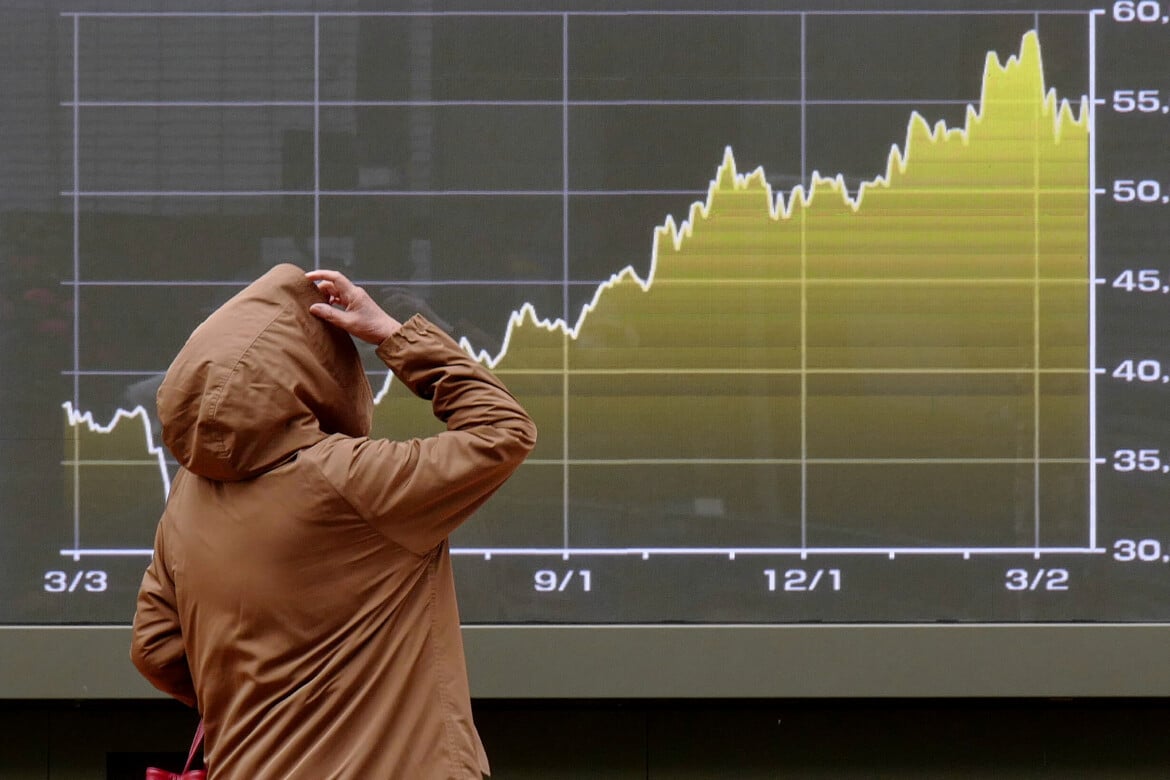
Even ceasefires become an opportunity for profit: the previous Friday, Iran’s announcement of the reopening of the Strait of Hormuz sent Brent crude down 9.1% (to $90.38, a five-week low) and European natural gas down seven percent, while stocks and bonds rose again, with the S&P 500 up 1.2% (up nine percent in April), driven by bets on a possible de-escalation. On Monday, however, markets had to grapple with the new closure of the Strait, this time due to the US blockade of the ports: another round of roulette, another opportunity for those who thrive on volatility.
The defense sector also has every reason to break out the champagne. Since the start of the conflict, shares of the main global military companies have seen significant gains, driven by increased public spending and expectations of new orders, in a trend that has now become structural. Over the past four years, European stocks alone have posted dizzying increases, with peaks of up to 1,000% – a rally that, according to Bloomberg analysts, could last until 2035. This is how war also fuels capital gains: death and ruins translated into “value” for shareholders.
This is where the fault line lies: on one side, inflation, eroded wages and public services under pressure; on the other, windfall profits in the energy, financial and defense sectors. And then there is an additional, more opaque level: insider information. The cases of winning bets tied to the exact timing of Donald Trump’s announcements have reignited the issue of political insider trading: those with early access to information can turn war into a financial opportunity. “Gentlemen, place your bets” – the downright fraudulent side of capitalism.
Originally published at https://ilmanifesto.it/il-business-della-guerra-cosi-leconomia-va-a-due-velocita on 2026-04-19