
Analysis
‘War and Conflicts’: Italy prepares a patriotic education for a militarized Europe
Italy is apparently a country at war, even if no one has formally proclaimed it, and an army of professionals is no longer enough: adolescents must learn to think of themselves as being involved in perennial military conflict.
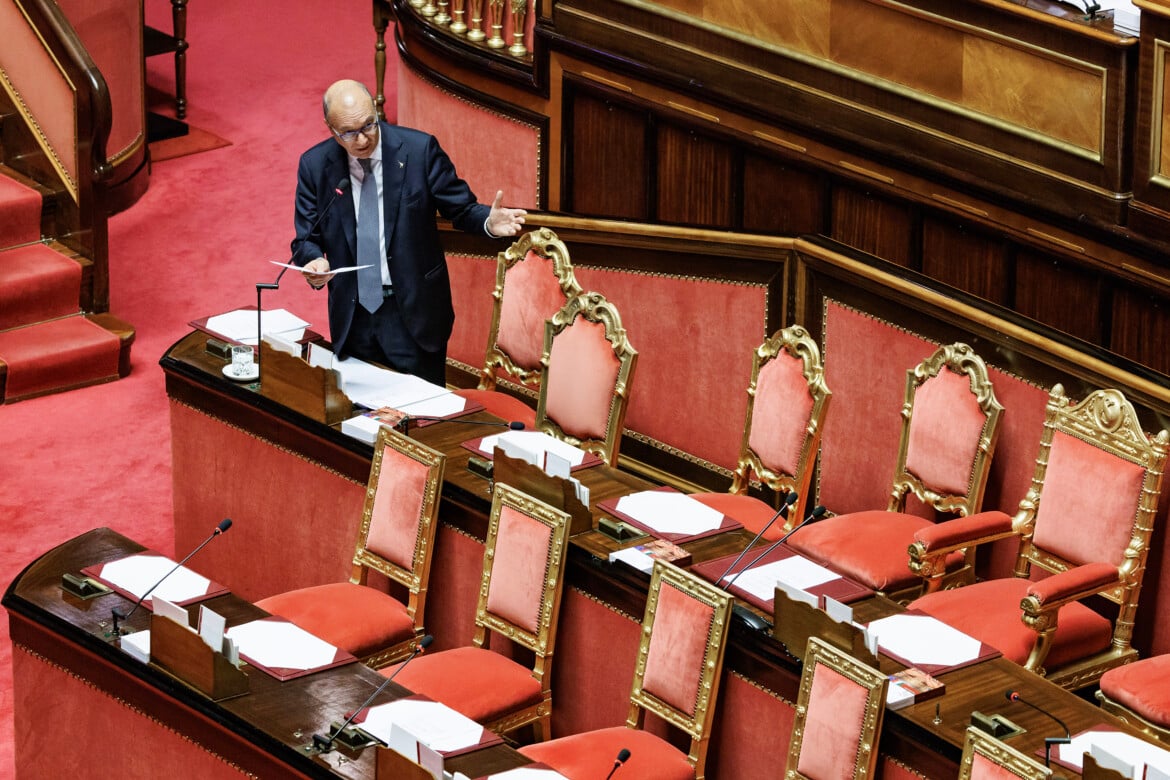
The right wing’s offensive on the “patriotic education” of young people continues at full speed. While the Minister of Education (and Merit) Giuseppe Valditara leads the march with the help of his colleague at Family and Natality, Eugenia Roccella, the rest of the executive and government agencies are marching in lockstep, ensuring an ideologically homogeneous environment.
Italy is apparently a country at war, even if no one has formally proclaimed it, and an army of professionals is no longer enough: adolescents must learn to think of themselves as being involved in perennial military conflict. It is no coincidence that on the website of the Authority for Children and Adolescents (AGIA) one is invited to answer a 32-page questionnaire titled “War and Conflicts,” put together with the Council of Girls and Boys.
In theory, the survey is reserved for young people aged 14 to 18; in practice, anyone can fill it out as many times as they want – whether their interests align with the warmongers or the pacifists. The editorial staff of il manifesto was also able to answer questions such as: “Si vis pacem, para bellum is a Latin motto meaning ‘if you want peace, prepare for war’: do you agree with that?” Or: “In your opinion, are violence and war inherent in human nature?” “Are pacifist mobilizations useful, useless or do they make no difference?” Or: “In case your country was involved in a war, what would worry you most?” The three answers: leaving my home, dying/the death of loved ones, future plans being compromised.
“This survey tool is far from being neutral: it closes off the possible futures,” explain the researchers from ROARS (Return On Academic Research and School). “If we don’t find it chilling to place the option of dying on the same level as not being able to realize one’s plans, it is because we have been gradually accustomed to this form of instrumental rationality, for which there are no possible alternatives. More than obscene, the result is grotesque.”
The head of AGIA, former journalist Marina Terragni (proposed for the job by Roccella, who liked her articles against trans people, as Terragni herself recounted), released the first data collected a week ago, although the questionnaire can still be filled in for another ten days. According to this data, 68% of respondents expressed disagreement with the statement “If my country entered a war, I would feel that I have a responsibility and, if needed, I would enlist.” “We wanted to know what young people feel who are bombarded every day by war news,” explained Terragni, insisting that the survey had nothing to do with Defense Minister Crosetto’s recent statements on the reintroduction of the draft. However, it’s hard to avoid that connection.
As highlighted by ROARS, “this questionnaire, which transforms war and peace into soft skills, contributes to normalizing the idea of war as a plausible future and of military mobilization as a collective responsibility.” Scholar Rossella Latempa explains: “The conceptual framework is that of European rearmament” which asks member states to “develop educational and awareness programs, particularly for young people, aimed at improving knowledge on defense and the importance of the armed forces and strengthening the resilience and preparation of societies for security challenges.”
According to Latempa, Crosetto’s recent remarks at the Defense Summit on the need for an “integrated ecosystem in which industry, universities, research centers and defense work in synergy” must also be read in this sense. According to ROARS, the minister’s words were an exhortation to build “an organism devoted to the construction of a new civil dimension of total mobilization in the name of the danger of imminent war, which would involve schools directly – the first link in this chain.” And Valditara has in fact already pushed through his plans on education by patriotic and nationalist propaganda.
On Sunday, the minister announced to Il Giornale that he had given his final signature to the contested new national guidelines. Although teachers and experts were still putting forward criticisms of the measure during hearings, Valditara invoked the U.S. national security strategy document as a pretext to accelerate. Like the rest of the government, the head of the Ministry of Education is not critical of Trump’s views; on the contrary, for him, the White House text supposedly confirms the “culturally vital” role of Europe and its alleged Catholic roots. Therefore, it is necessary to “put our priorities back in order” and ensure that the students have it clear that “our civilization is born from Athens, from Rome, from Christianity, from humanism” – as filtered through identitarian and conservative notions, that is.
In the new school programs, there is also “education on respect” – an ersatz replacement for sex and relationship education, which is only available with parental consent. Because discussing the body would be scandalous, unless it’s exclusively as a weapon of war.
Originally published at https://ilmanifesto.it/europa-e-moschetto-la-scuola-del-governo-prepara-alla-guerra on 2025-12-09