
Reportage
The avoidable death of an agricultural worker in Italy
These workers are exploited to the bone, earning starvation wages and living in precarious conditions, just a few miles from the charming town of Amalfi and the peaceful landscapes of Cilento.
The delay in getting to a hospital and secondary infections – caused by prolonged exposure to chemical agents – are what killed Paul Neeraj, the young Indian man admitted to Ruggi Hospital in Salerno on April 24.
He had been brought to the emergency room during the night between Friday, April 10, and Saturday, April 11, unconscious and with his legs gangrenous, after many days without medical care. A secondary infection had taken hold over already severe wounds that had compromised his muscles and internal organs. He fought for his life for another two weeks; hyperbaric chambers and continuous transfusions could not save him from the consequences of a life spent on the margins. He was exploited and left to die, after days of agony.
The body, transferred to the morgue, has now been seized by authorities. Sources within the hospital are saying that the clinical picture, laboratory tests and diagnostic imaging point to a case of multi-organ failure so extensive that it may point to systemic intoxication from direct contact or indirect exposure to irritants, chemicals or solvents. He may also have inhaled such substances, given the severe pleural effusion; however, based on the condition of his lower limbs – with damage to the skin, subcutaneous tissue, dermis and even muscle – it appears more likely that these were burns caused by the corrosive action of chemicals he came into contact with.
Paul did not speak about what happened during the moments when he regained consciousness. To settle the matter, samples were sent for toxicological analysis; the results will arrive too late to save the young man’s life, but they will help determine what he was exposed to. From what has emerged so far, while we cannot rule out that he worked in a greenhouse or in the fields – where the use of fertilizers and herbicides is also at extreme levels – it is more likely that he worked at one of the many buffalo farms in the area, some of which also have leather processing workshops.
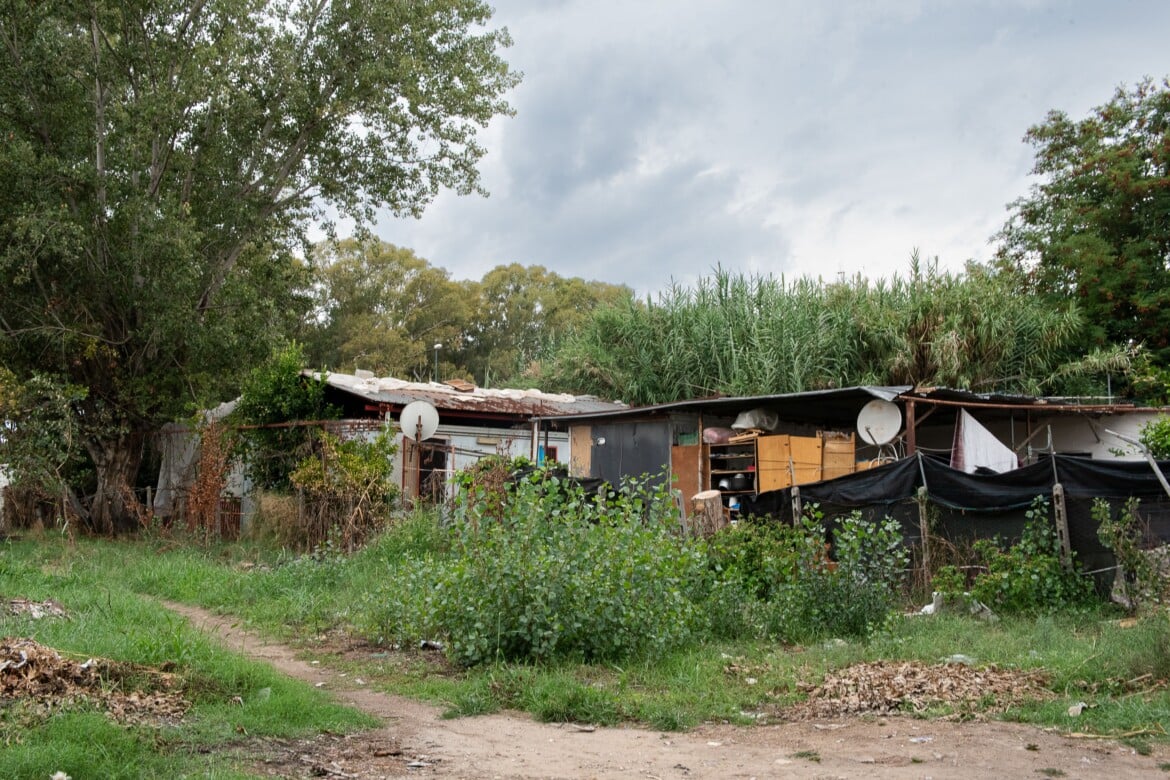
Paul was 32 years old. He had arrived in Italy from India and found makeshift lodging and a job in the Piana del Sele, the vast agricultural area in the province of Salerno stretching between Pontecagnano, Eboli, Capaccio and Bellizzi, covering an expanse of about 450 kilometers and over 6,000 hectares of greenhouses. This is the heartland of Italy’s fresh-cut produce industry, a thriving agribusiness with massive revenues, and a center of excellence for animal husbandry. Everyone in Italy is familiar with the bagged salads from brands like Bonduelle and Rago or the buffalo mozzarella from Battipaglia, but few know anything about the more than 12,000 immigrant workers employed across greenhouses and livestock farms. They are mostly Moroccans, Romanians and Indians, but also people from sub-Saharan Africa.
These workers are exploited to the bone, earning starvation wages and living in precarious conditions, just a few miles from the charming town of Amalfi and the peaceful landscapes of Cilento. Few in the Plain are willing to speak out; economic success arrived late, at the end of the 1980s, and it’s not easy to raise one’s voice in the gloomy atmosphere that envelops the area.
Green and Left Alliance (AVS) Deputy Franco Mari, a member of the parliamentary Commission of inquiry into labor exploitation and workplace safety, spoke out on the matter: “We must shed light as quickly as possible on this incident, about which we know far too little. Furthermore, there have been other deaths too. I have already requested the Commission’s Bureau to conduct an inspection of the Piana del Sele. This is not an isolated case,” he says.
But few are willing to say anything in the region itself, and those who do are failing to break through the institutional silence. Nothing further has been heard from the investigating authorities regarding the other deaths involving workers in the area: at least six in the last year and a half alone, since November 8, 2024, when Manjinder Singh Rimpa died after being crushed by a tractor.
A few union organizers are trying to speak out, refusing to resign themselves to people working 365 days a year, 24 hours a day on the livestock farms, without breaks or vacations. “The wages are certainly not what the [collective] contract sets out; people work for less than minimum wage and non-stop,” says a local union representative who asked to remain anonymous. “As far as I know, few companies work in shifts; at most two daily shifts that allow workers a little more breathing room.”
These are modern-day slaves, forced to obey the boss to hold onto a residence permit or repay the debt incurred to reach Italy through the various Immigration Quota Decrees, living in barns, shacks and abandoned farmhouses, and working in often terrible conditions.
“Workplace safety is lax. I don’t think a mere pair of boots can be a shield against injuries or potential illnesses. We are talking about herds of buffalo numbering up to 600 head, wallowing in the mud. But I don’t know if these conditions can cause the kind of damage this young man suffered,” the union representative continues.
And the situation for those working in the fields or greenhouses is certainly no better, with wages ranging between €30 and €40 for a full day’s work and constant exposure to chemicals such as herbicides and fertilizers. “Agriculture is heavily chemicalized throughout the Plain, but naturally the carpet bombing with chemicals is greater in the greenhouses,” says the union representative. “When working, one needs to have appropriate clothing. If certain operations are being carried out, no one must enter the greenhouse for several days, and I don't think these precautions are being respected – at least not by everyone.” Life here is marked by exploitation, suffering and extreme marginalization, for which there seems to be no solution.
“We still don't know whether this man was working in the fields or in other sectors, but we know for certain that no one should be reduced to this state in a civilized society,” General Secretary Silvia Guaraldi of the FLAI CGIL agro-industrial workers’ union said recently, emphasizing that, regardless of the uncertainties about the course of events, “reducing a man to these conditions means leaving him to rot in silence, far from the eyes of the world, out of fear of legal repercussions or to cover up undeclared work and the illegal gangmaster system.” For the FLAI union, this represents “the failure of the workplace safety system and the concrete form of the dehumanization of migrants that the government has been carrying out for years.”
Originally published at https://ilmanifesto.it/nella-piana-del-sele-si-muore-di-lavoro on 2026-04-26