
Analysis
Taxing the rich to care for Italians: Signatures start for 1% tax on the 1%
The measure would affect fewer than 500,000 people, while we are seeing a growth in the number of families living in absolute and relative poverty.
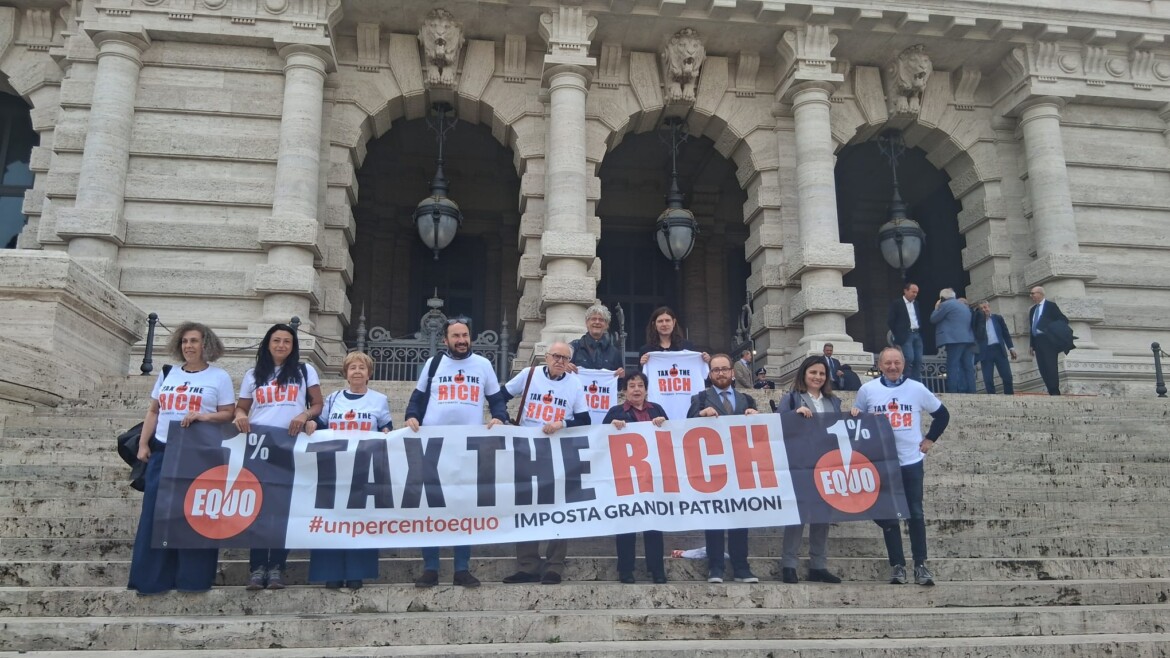
Up to €60 billion a year could be obtained from a tax on large fortunes, excluding one’s primary residence, and up to €8 billion from the reform of the inheritance tax. These sums should be allocated to public health, education, housing, the environment, workplace safety, disability and income support, in addition to a reduction in the personal income tax (IRPEF).
This is what the promoters of the citizens' initiative bill are proposing, who organized themselves as the “1% Equo” (Fair 1%) committee. A tax starting at 1% is precisely their goal for the “tax on large fortunes,” which would provide “a first signal of restoring the fiscal progressivity provided for by Article 53 of the Constitution.”
The initiative was presented on Thursday in Rome, in front of the offices of the Court of Cassation, by the first signatories, including the secretary of the Communist Refoundation Party, Maurizio Acerbo; Anna Camposampiero (European Left); Alfonso Gianni, former Undersecretary for Economic Development; Rosa Rinaldi, former Undersecretary at the Ministry of Labor; journalists Riccardo Staglianò, Francesca Fornario and Benedetta Sabene; and economists Pier Giorgio Ardeni and Marco Veronese Passarella. The organizing committee is composed of a broad and diverse group of more than 30 economists, university professors and researchers committed to fiscal and social justice.
The proposed tax reform cannot be reduced to the confused discourse around a “wealth tax” – an expression used inappropriately on the left and brandished as a bogeyman by the right to terrify the impoverished “middle class.” The proposal envisions something entirely different: tax rates ranging from 1% to 3.5% on the portion of assets exceeding the threshold of €2 million, and an alignment of inheritance tax rates to the European average. What is being proposed is a rebalancing of the entire tax system in the name of a constitutional principle. “The absence of a tax on large fortunes, combined with the partly regressive nature of current indirect and property taxes, leads to a systemic violation of this principle,” reads the report filed with the Court of Cassation.
The measure would affect fewer than 500,000 people, while we are seeing a growth in the number of families living in absolute and relative poverty. Over the next six months, the organizing committee will launch the collection of the 50,000 signatures required to submit the proposal, both via an electronic platform and through booths set up across the country. The stated goal is to gather a much larger number of signatures, starting with the website unpercentoequo.it, where it is possible to join the campaign from May 15 to November 15.
“Every day that passes without this law, we lose 71,232,876 euros in public services,” reads the homepage. The result is, for example, the inability to find drivers to operate buses and trams in Milan. Unless we go to Tunis to recruit 30 drivers for a monthly salary of 1,400 euros. On a fixed-term contract – because one should never be too generous with certainties. This tragic situation, well known also to those who do not live in Milan, stems from the massive shift of wealth benefiting capital in the form of financial rent and profits.
For more than 40 years now, both declining wages and public taxation have served to sustain this shift in wealth. The results are plain for all to see: a healthcare system in shambles, a welfare system reduced to Swiss cheese and traditionally unfair, wages that do not even last until the middle of the month and so on. A law like the one proposed by the campaign on taxing the wealthiest segment of the population could start off a reversal of this trend in a context that is moving in the completely opposite direction.
Originally published at https://ilmanifesto.it/tassare-i-ricchi-per-curare-il-paese-parte-la-raccolta-firme-1-equo on 2026-05-08