
Reportage
Successful April 25 soured by two shots from an airgun in Rome
"I feel shaken and deeply outraged, because this shows that there is still a great need for these demonstrations, since fascists who act like cowards are still out there and we must remain very vigilant."
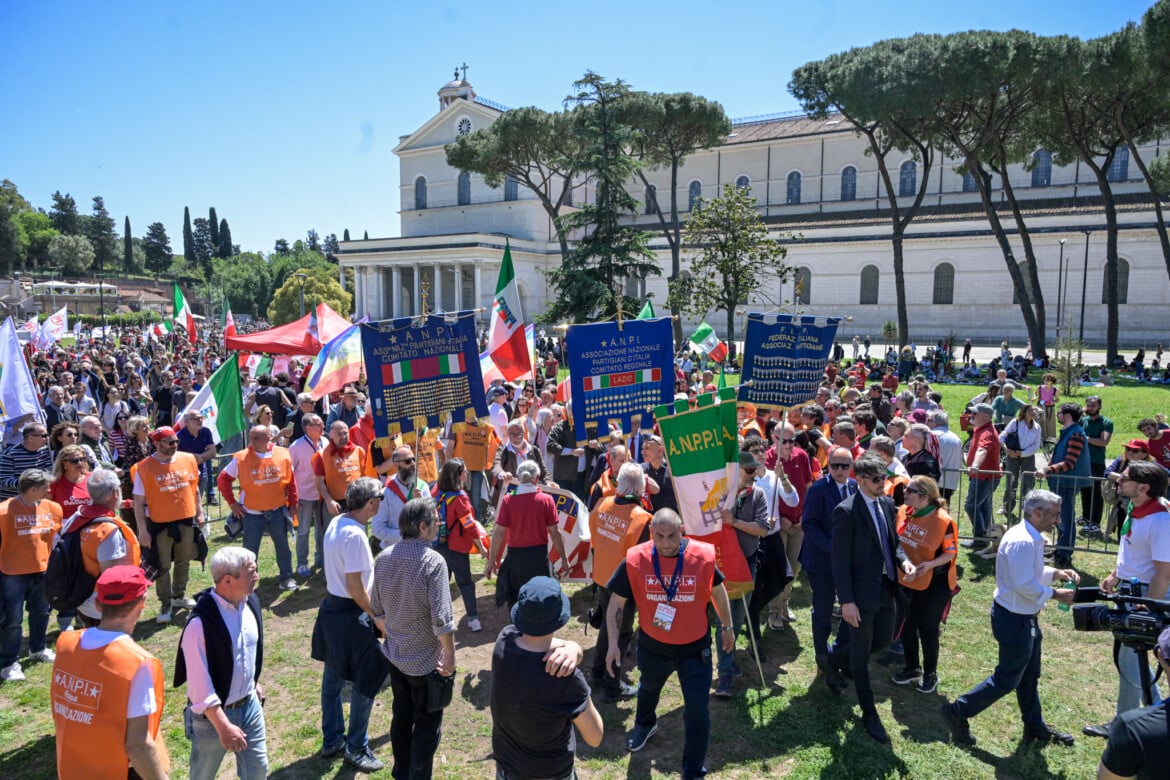
The speeches from the stage had just ended. The thousands of people who marched to Parco Schuster were sitting on the grass. Most of them were families; children were playing among the Palestinian flags and the flags of the National Association of Italian Partisans (ANPI). At one point, the music stopped: “Attention: two of our comrades have been shot with an air gun. They are both in the ambulance and are not seriously injured. This is an extremely grave act that we are reporting to the authorities,” the organizers announced from the stage.
Marina Pierlorenzi, secretary of the ANPI chapter for Rome and the Lazio region, was still in shock as she recounted what happened: a man with his face covered by a full-face helmet and wearing a military green jacket (some described it as a camo jacket in the first frantic minutes) fired an air gun at two participants from a scooter.
The victims were a married couple, both ANPI members, wearing the partisans’ tricolor scarves. The woman, identified as R.G., was hit in the shoulder; her husband, N.F., was struck in the neck. They were treated immediately by the ambulances on site and their injuries were minor. They subsequently filed a report at the police station.
“I feel shaken and deeply outraged, because this shows that there is still a great need for these demonstrations, since fascists who act like cowards are still out there and we must remain very vigilant,” the woman said. “We must not let our guard down.”
“We are all shocked, because these are comrades who came here to be together during a time of great celebration to honor the Resistance and talk about peace, to have a good time,” emphasized the president of the Rome provincial branch of ANPI. “The event was planned in this park so that children and elderly people could be with us all day.”
What happened seems clear, with a potential criminal charge (investigators are reportedly considering pursuing a charge of aggravated assault), even though no one has claimed responsibility. Officers from the Digos special police force have collected video evidence. What seems certain is that the shooter’s targets were the participants in Saturday's April 25 event.
“A disturbing incident, an attack on a day that is a symbol of our country’s democratic values,” commented Rome’s mayor Roberto Gualtieri, who until moments before the shooting had been on stage with the national secretary of the CGIL trade union Maurizio Landini and the capital’s partisans.
“It was an act of intimidation, deliberately directed against those celebrating the Resistance and Liberation,” said Amedeo Ciaccheri, president of the 8th Municipal District where Rome’s April 25 celebration is held every year. Nicola Fratoianni, leader of the Green and Left Alliance (AVS), said the incident was “yet another episode in a long series of intimidations, threats and acts of fascist violence that have been happening for far too long.”
Notably, there was no comment from the right-wing parties, who in other cases targeting those on the other side of the spectrum have been quick to sound the alarm about “violence.”
Up until that point, the day had been a success, with the streets of Rome joining in celebration, from the Garbatella and Pigneto neighborhoods all the way to the other large march in Quarticciolo. The “incidents” of previous years did not recur either, i.e. the mutual provocations between some members of Rome’s Jewish community and certain student collectives. The only boos heard were those directed by some activists from the communist student organization Cambiare Rotta at a delegation from the Italian Radicals and +Europa parties who were carrying Ukrainian flags. According to some reports, the students also used pepper spray against law enforcement.
Otherwise, the atmosphere was festive, punctuated by protest anthems, the traditional songs of the mondine (female rice paddy workers) and testimonies from surviving partisans like Mario Di Majo, who moved and entertained the crowd: “In San Lorenzo [one of the Rome neighborhoods bombed during World War II, n. ed.] we were all communists, and when the fascists showed up, we grabbed them and beat the crap out of them.”
Some girls translated his words for an American friend, who found it amusing and said: “I knew Italy had liberated itself from the Nazi-Fascists, but I didn't realize they still celebrate it.”
The partisan handed the floor to the mayor, and then Landini wrapped up by speaking about his parents who were partisans, social justice and opposition to war. Applause broke out, along with raised fists and chants for Palestine. Maurizio, a taxi driver, got caught up in the moment too: “I was moved, even though I had just swung by to pick up my son and his friends to take them across town.” Like many other young people, they had decided to continue the day by joining the capital’s other major march as well.
For a few years now, on April 25 much of Rome’s activist and social center scene has been gathering in Centocelle. In East Rome, between Centocelle, Quadraro and Torpignattara, the Resistance played a strategic role: while the Allies had landed at Anzio and were advancing toward Rome, the partisans were tasked with wearing down the Nazi-Fascist troops – a mission they carried out with the stubborn determination typical of the capital’s suburbs. Saturday's march set off at 11 a.m. from Piazza delle Camelie to reach Quarticciolo, a neighborhood targeted by declarations of security emergencies and the government's Caivano juvenile crime decree, but where the strong social fabric has managed to impose an agenda entirely different from the purely repressive one.
Before the start, the activist-made monument “Potential Targets 2026” was unveiled. It depicts two silhouettes representing a woman and a child who are about to be executed. “Yet they do not give up: their hands crossed behind their backs, fingers making the victory sign, are a hymn to freedom. Two indomitable, unyielding, resistant figures. Each wearing a keffiyeh, a symbol of the Palestinian people's dignity,” explained Alessandro “Mefisto” Buccolieri, one of the artists behind the artwork. It draws a symbolic thread which connects to the square at Porta San Paolo: the woman and the child are the sixth and seventh silhouettes of the other monument located in front of the Cestius Pyramid, which was inaugurated on April 25, 31 years ago. Back then, the “potential targets” were five statues dedicated to Holocaust victims: a homosexual, an immigrant, a Jewish woman, an anti-fascist and a Romani woman.
Along the way, at least 20,000 people joined the march. A speech delivered from the truck at the head of the procession captured the spirit of contemporary resistance perfectly. It was delivered by Graziella Bastelli, a longtime activist in the struggles at the Policlinico hospital since the 1970s and a constant presence among the feminist movements: “We must not stop fighting,” she said, addressing the younger girls in the crowd. “Even when it all seemed more difficult than ever, the conflicts we kept alive helped change the world.”
Originally published at https://ilmanifesto.it/uno-sparo-in-mezzo-alla-grande-festa-feriti-due-antifascisti on 2026-04-26