
Reportage
Russia made it a crime to remember the gulags, but Memorial refuses to stop
‘Anyone associated with Memorial, even through a single social media post, can be accused of extremism.’ But affiliate organizations will continue the work.
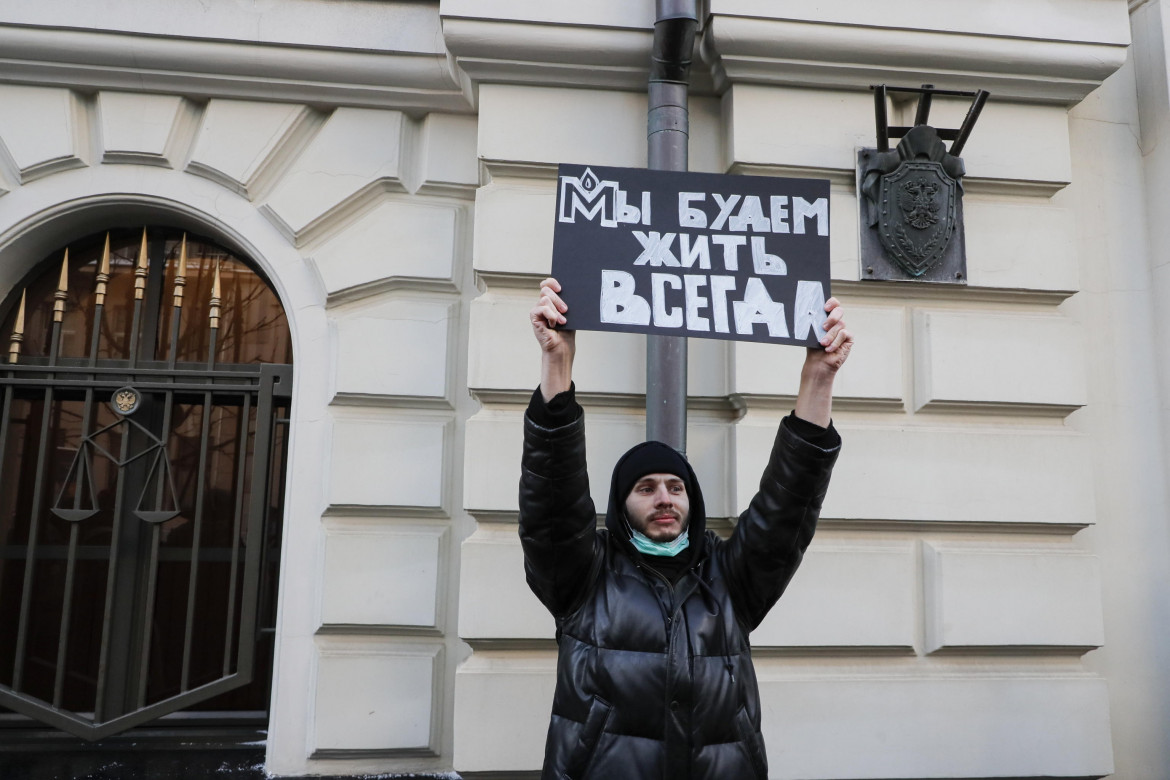
“Manuscripts don't burn,” Mikhail Bulgakov wrote, despite censorship, daily despair and the arrogance of power. For Russian culture – which, during the darkest years of Soviet repression, confined its dissent to underground literature, as generations of writers and poets were sent to the Gulag – the April 9 ruling is a harrowing throwback to the past. The Russian Supreme Court upheld the petition filed by the Justice Ministry shortly before Easter, declared Memorial an extremist organization and banned it throughout Russian territory.
Memorial was officially founded in the second half of the 1980s by a group of dissidents whose goal was to recover the historical memory of Gulag internees and their families in order to expose the abuses of the Soviet authorities and fight for the civil rights of the Russian people. Among the founders were Andrei Sakharov – the leader of the Russian civil opposition who died in 1989 – Oleg Orlov, Lev Ponomarev, Sergei Kovalev, Irina Shcherbakova, Boris Belenkin and Arseny Roginsky, among others.
“Virtually everyone in Russia during the Soviet era had at least one relative who had been imprisoned in the Gulags,” Belenkin told us a few months ago. “I myself come from a family that suffered the consequences of Stalinist repression. Before Perestroika, no one had ever been able to freely tell those stories without being sent there themselves. People came constantly to the small room we had opened to the public in Moscow with terrible stories. No one called them; people came to us on their own, sat down and spoke of their grandparents, parents or some friend who had been disappeared for years, perhaps forever. It was a very selective way of passing on memory. Some made a full-fledged confession that lasted over an hour, while others spoke for less than ten minutes. Many came to us to find something out rather than to tell us something.”
On October 30, 1990 – the anniversary of a historic hunger strike by some Gulag inmates in 1974 – Memorial activists brought a boulder from the Solovki Islands camp, one of the harshest in the Soviet repressive system, to Moscow. The boulder was placed in front of the Lubyanka building, then the headquarters of the KGB and now of the FSB (the Russian intelligence service), and the following year the Supreme Soviet institutionalized the anniversary.
Since the dissolution of the USSR, the need to bear witness gradually diminished among a population that was now free to speak out. But Memorial never ceased its activities, pursuing three main objectives: promoting the development of civil society, citizens’ awareness of their legal rights and a democratic state under the rule of law to prevent a return to totalitarianism; assisting in the spread of democratic values and the affirmation of individual rights; and the rehabilitation of victims of political repression alongside the dissemination of information about those forms of repression. Its activities were divided between Memorial International and the Memorial Human Rights Defence Centre.
This continued until 2016, when the courts in Vladimir Putin's Russia declared it a “foreign agent,” and 2021, the year when both Memorial and the Memorial Human Rights Defence Centre were shut down. The following year, the organization was awarded the Nobel Peace Prize. “With the April 9 ruling,” explained Giulia de Florio, president of Memorial Italia, “they want to target a phantom international ‘Memorial’ movement, which doesn’t exist legally or formally, and according to the logic of the Russian authorities, anything bearing the name ‘Memorial’ becomes subject to prosecution. Anyone associated with Memorial, even through a single social media post, can be accused of extremism.”
For Oleg Orlov, who was released as part of a prisoner exchange with the US from the prison where he was being held for condemning the invasion of Ukraine, this development is not unexpected: “We expected it, but Memorial will continue to do everything it can from outside Russia. Our work does not stop.”
Still, it becomes far more difficult. “The government's stated intention,” de Florio says, “is to eliminate everything that Memorial is and has been, the issues we have addressed and the struggles we have waged. It is a clear sign that, for Vladimir Putin, historical memory must be the sole prerogative of the government, and anyone who touches the subject ends up in a penal colony. It is all part of a plan aimed at rewriting the Soviet past: erasing the dark chapters, glorifying the victory in World War II and making up memory to suit particular purposes. The citizen must be at the service of and live for the state, not vice versa; the citizen must simply obey.”
But activists from the many affiliate organizations of Memorial International in various countries have made it known that they will continue their work, from outside Russia for now. And that the archives have all been digitized – these cannot burn either. “We will continue to preserve that historical memory and we will continue to fight for the freedom of the Russian people from oppression.”
Originally published at https://ilmanifesto.it/la-russia-condanna-memorial-ora-ricordare-i-gulag-e-un-reato on 2026-04-10