
Analysis
Repression and insults: Italian youth say ‘No’ to authoritarian Meloni
No one can say they didn’t see coming the resounding ‘No’ from Italy’s youth. It is safe to say that all of the government's policies for children and young adults can be summed up in one word: repression.
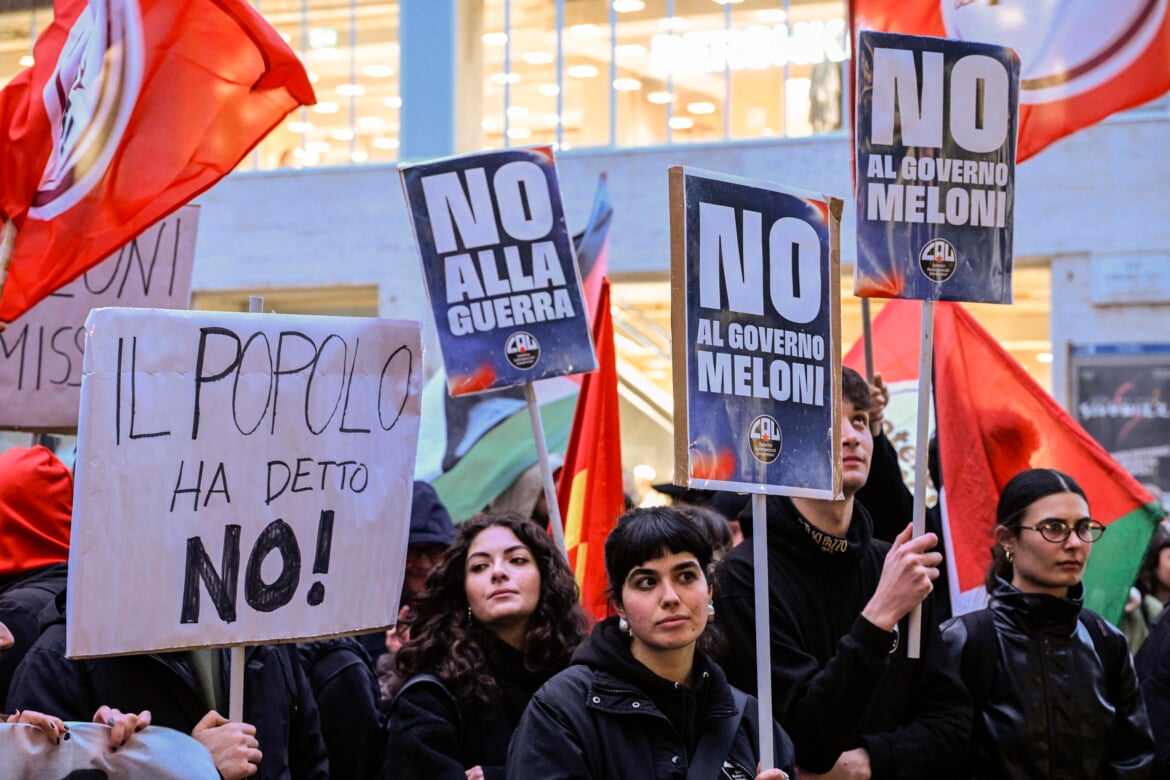
The right wing does not like young Italians. This mistrust did not just emerge today, after the analysis of the justice reform referendum vote highlighted the role of the under-40 demographic in the proposal’s defeat. It was evident from the very first days of the Meloni government that the administration not only disliked youth participation but actually had a plan to “humiliate them,” to quote one of the first unfortunate remarks by Giuseppe Valditara when he began his tenure as head of the Ministry of Education and Merit.
Three and a half years later, it is safe to say that all of the government's policies for “the youth” – what the right prefers to call them – can be summed up in one word: repression.
Children must be re-educated with the Bible in hand, teenagers are seen as criminals in the making and university students must be punished. Even more so if they are of foreign origin, as most recently demonstrated by the so-called “anti-maranza” law targeting street youth, which contains a racist slur in its very name.
While the government issues decrees in the wake of sensational news stories under the pretext of a “youth crime emergency” to repress them, the strategy to re-educate them is being planned and carried out with clear-eyed precision by Valditara and University Minister Anna Maria Bernini. The latter is the architect of the largest mass dismissal of researchers on record and has been very active in banning demonstrations against the genocide of Palestinians inside universities. After the violence deployed by the police against high school students marching in Pisa, police charges have also reached inside university campuses. Such scenes had not been seen in over 30 years, but in the last two years they have become commonplace.
This is partly because the government is issuing one security decree a year – the cornerstone of its mechanism for repressing dissent. It all began with the anti-rave decree just one week after the executive took office. This had little to no effect: illegal raves continue to take place. Then, following a gang rape of two minors, came the Caivano decree, which later became a model for placing neglected city suburbs with strong grassroots and social activism under special administration.
Meanwhile, these measures have sent a slew of young people to prison, as evidenced by the overcrowding in juvenile detention centers repeatedly denounced by organizations such as Antigone. Criminal investigations are also being used liberally for the nonviolent protests of young environmentalists from Last Generation and Extinction Rebellion due to the January 2024 law against “eco-vandals.”
In 2025 we saw the executive's first security decree openly named as such, which later became law. It increased penalties for those who protest – even peacefully – against state infrastructure, whether this is Lega leader Matteo Salvini's pie-in-the-sky project for the Messina Strait Bridge or the high-speed rail line in the Susa Valley. It also introduced the new crime of “arbitrary occupation of property,” established red zones and expanded legal protections for police officers and military personnel under investigation for acts committed while on duty. Not to mention the very harsh new regulations against people locked inside prisons or Repatriation Centers.
This year's new security package pushes the measures contained in the first even further, with the “baby gang” alarm turning into a “maranza” alarm. Meanwhile, the government has rolled out metal detectors in schools. A quasi-fascist measure is also being introduced: preventive police detention for up to 12 hours to “detain individuals suspected of wanting to commit violent acts during demonstrations,” alongside fines of up to €20,000 for those who organize protests.
Finally, there is the bill under discussion in the Senate regarding rape, which fails to mandate explicit consent. The women who protested in front of the Senate building were manhandled brutally by police in riot gear.
Those who claim they didn't see the youth vote coming are wrong. The government, for example, saw it coming perfectly well – so much so that it tried to boycott it. Unlike the 2024 European elections and the 2025 referendums, where exceptions were made to allow out-of-town students to vote, this procedure was not activated for this latest referendum. It didn't matter: many hit the road anyway to vote “No.”
“My partner and I traveled from Lombardy down to Calabria and back in 48 hours,” says Alessandro. “I didn't make that trip even when Berlusconi was in power. We wanted to send a message to Meloni, who has taken a terrifying turn.”
Miriam, who has been working in London for a year, agrees: “The plane ticket was money well spent. I am terrified of an authoritarian drift, and the rape law cries out for vengeance.”
“I stayed up all night to catch the train back,” says Elena, who is from Florence but studies in Turin. “The referendum was too important. I was so satisfied that I helped the 'No' side win.”
And Fra, a 25-year-old who studies in Rome but returned to Varese to vote, added: “There is a lot of awareness among those in my age group. The prime minister dug her own grave: if she wanted to win over young people, she did the exact opposite.”
The guest appearance on rapper Fedez and Mr. Marra's podcast didn’t do the trick. (With contributions from Gaia Battaglia)
Originally published at https://ilmanifesto.it/repressione-e-insulti-il-no-dei-giovani-alla-deriva-autoritaria on 2026-03-25