
Reportage
Rebuilding humanity with painting and laughter
Marah and Ahmed's stories converge on one core idea: that of transforming pain into meaning and tragedy into a powerful human act. Painting and laughter are not mere entertainment – they are real tools for survival.
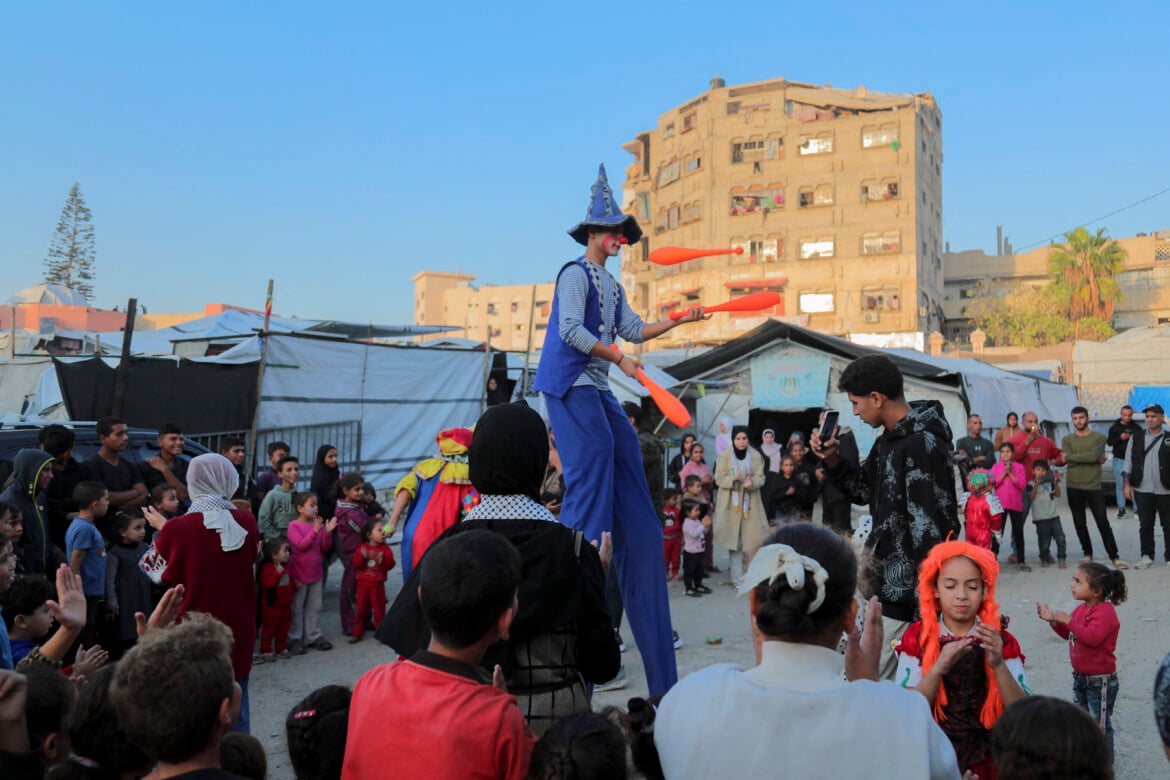
Gaza is not merely a territory besieged by bombings and news of displacement and destruction; it is a human experience that tests the strength of the spirit and teaches us how pain can be transformed into life, and how creativity can become a weapon against a harsh reality. Here, art is not a luxury, and laughter is not an indulgence: they are tools for survival and a way to resist daily suffering.
In Gaza, two stories embody the spirit of the city: the young artist Marah Al-Zaanin and the clown Ahmed Abu Sukkar. Each has chosen their own path to confront loss, transforming pain into hope and destruction into life.
Marah Al-Zaanin began her artistic journey as a teenager, when she discovered her talent for expressing emotions through colors, but the war turned her life upside down. Her displacement from Beit Hanoun to Gaza City and her life in an UNRWA tent were not the end of her journey, but the beginning of a new adventure. Inside her tent, the walls became a living gallery that tells the story of Gaza's tragedy: the faces of starving children, of mothers who have lost their sons and daughters, of men and women who have endured the bombings and of journalists who have tried to convey the truth to the world. Black and white are predominant in her paintings, reflecting the harshness of reality, but this choice also gives her art a powerful language to express pain.
“Painting has become my world,” Marah says. “A refuge from fear and psychological pressure. I look at photos of people who lost their lives or suffered from hunger, then I recreate them on canvas to release my emotions and preserve their memory. Sometimes I feel that every painting is a message saying: we are still here, and we are carrying on.” She adds: “Sometimes children come to me and ask what this painting means. I explain that every line and every color tells the story of someone who has experienced pain but did not give up. Art makes us stronger and reminds us that hope never dies.”
She has divided her tent into different sections: one for famine, one for the martyrs, one for daily life during the war and one for the things she loves, trying to maintain a balance between pain and hope.
Marah's art is not just something to keep busy, but a defiance of oblivion, a message to the world that Gaza is not just a tragedy, but a living city that never stops creating. Every painting, every brushstroke, every drawn face is a testament to the human capacity to transform pain into meaning.
For his part, the clown Ahmed Abu Sukkar deals with loss in a different way: by bringing smiles to children's faces. He lost his entire family during the war, yet he has refused to let grief consume him. “Every child's laugh gives me a new lease on life,” Ahmed says. “Even if I lose everything, these smiles remind me that life goes on and that I can still make a difference.” But behind those smiles, Ahmed carries his private pain. Every time he plays with the children, he remembers his sister's murdered kids: Farah, Omar, Ranim and Reem. Every time he laughs with other children, a lump rises in his throat as he remembers them, and he feels a deep, persistent sadness – yet he finds the strength to carry on despite the pain.
He recalls his first experience with a child who laughed for the first time after everything that had happened: “I made some simple movements, and the child laughed. In that moment, I felt something indescribable. It was as if my heart had come back to life. I realized that every smile is a small victory against war and loss.” Sometimes, he adds, “I pray before starting my shows for the children, asking for the strength to continue. Every day I see children expressing joy despite the hardships, and this makes everything I have lost feel like it was not in vain.”
Despite the weight of losing his family, the children give Ahmed the strength to carry on: “I believe I have to do this for my father, my brothers and their children. Laughter is not a luxury; it is life. It is true resistance in times of war.”
Marah and Ahmed's stories converge on one core idea: that of transforming pain into meaning and tragedy into a powerful human act. Painting and laughter are not mere entertainment – they are real tools for survival and a living archive of Gaza's suffering and hope. What these artists do redefines resistance: it is not just about weapons or politics, but about preserving humanity and rebuilding it amid the rubble. Marah preserves memory on the walls of her tent, and Ahmed plants smiles in children's hearts. Both are proof that Gaza has not surrendered and that human beings are capable of creating meaning even amid destruction.
When you see a tent transformed into a gallery or a clown spreading smiles amid the rubble, you realize that Gaza teaches a profound lesson: life is worth defending, and art and laughter are survival tools no less important than food or shelter. Gaza is more than the war – it is a city that teaches that resilience is not only patience, but also innovation, the preservation of humanity and a defiance of pain. Anyone who visits its tents or hears the laughter of its children knows that resistance is not just about struggle, but about the ability to remain human and to bring life into being where everyone thinks it has vanished.
Art is defiance, laughter is resistance and hope is a daily act, even when it seems impossible. This is Gaza's greatest lesson: even in the darkness, a person can find a way to turn on the light, whether with a brushstroke of color or a child's laughter.
Originally published at https://ilmanifesto.it/riscostruire-lumanita-con-pittura-e-risate on 2026-04-07