
Reportage
Our prison at sea: Beaten, humiliated, mocked and beaten again
And so, at 2 a.m. on April 30, our boat, the magnificent Holy Blue of the Global Sumud Flotilla, halted its desperate race toward Greek territorial waters, and we 12 passengers were transferred first to a military rubber dinghy and then – amid kicks, punches and slaps to the face – aboard our prison ship.
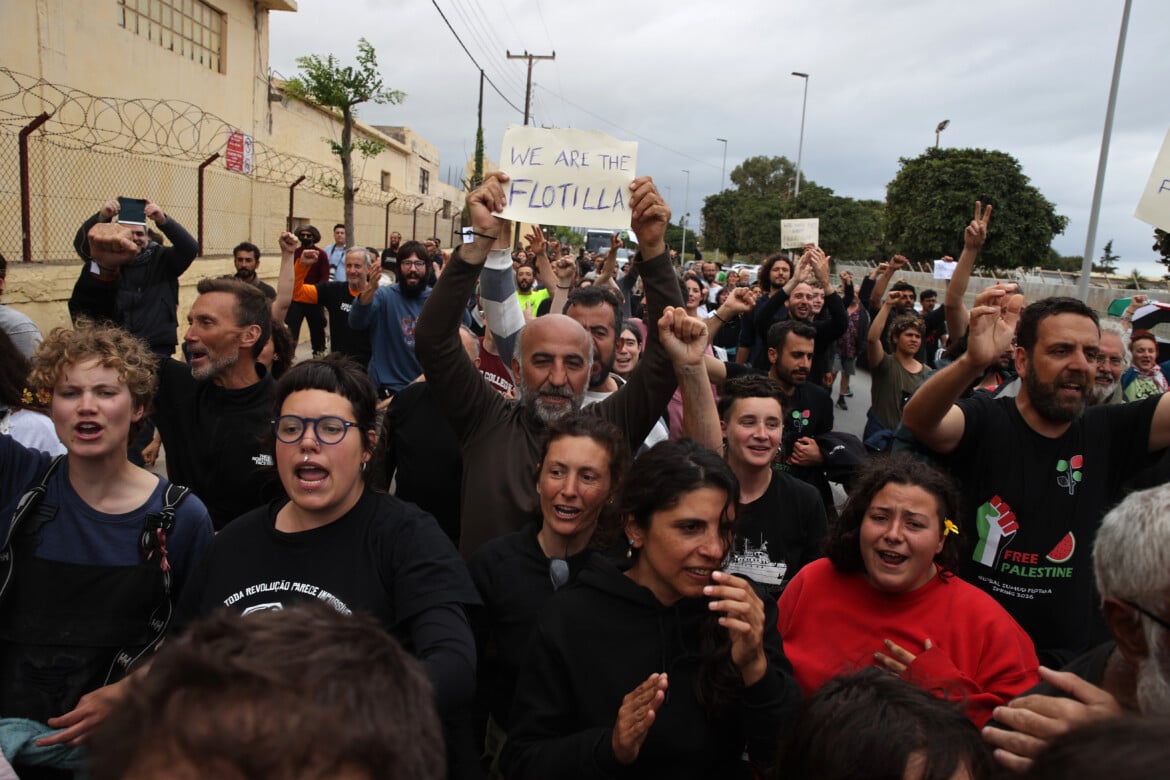
We were held captive by Israeli special forces soldiers for one day and two nights, but during all this time we never managed to see their faces. Our floating prison consisted of four shipping containers arranged in a rectangle and framed with barbed wire, with 180 of us imprisoned in the middle.
They, the soldiers, stayed above, along the steel walkways that ran around the entire perimeter of the military cargo ship on which we were confined. Some took pictures of us, others waved hello with their hands or made little dances to mock us. Everyone was in full combat gear.
They had submachine guns constantly pointed at us, bulletproof vests, magazines in plain sight and balaclavas always pulled down over their faces. We could only see their eyes, and the entire spectacle, in its layers of grotesque, seemed to be straight out of a poor ripoff of a Squid Game script.
For a day and two nights, no one told us anything. Quite literally, we had no idea what to expect. We only knew we were sailing southeast – as we could guess that much by observing the position of the sun – and therefore toward deportation to Israel, the Ktzi'ot prison and who knows what other horrors.
Looking back now, what seems particularly incredible is the brutal speed at which all of this happened. We knew the reputation of the Shayetet 13 commandos, the same soldiers who had stormed the previous flotilla in October. But we never would have imagined that we’d be facing them after just three days of sailing, while we still hadn’t completed the crossing between Sicily and the island of Crete. “There they are,” someone shouted, “here they come.”
Within a few seconds, that small beacon we had seen light up on the horizon turned into a blinding beam of light, foreign voices began bellowing “Raise your hand! Raise your hand!” and the red lights of laser sights suddenly appeared on our chests and heads.
And so, at 2 a.m. on April 30, our boat, the magnificent Holy Blue of the Global Sumud Flotilla, halted its desperate race toward Greek territorial waters, and we 12 passengers were transferred first to a military rubber dinghy and then – amid kicks, punches and slaps to the face – aboard our prison ship.
First, after shoving us along the deck, slapping us in the testicles and forcing us to walk bent over with our arms twisted behind our backs and to kneel at every step, the soldiers stripped us of everything, taking even the dirty handkerchiefs out of our pockets, in addition – obviously – to our credit cards, passports and medications, including life-saving ones (which no one ever saw again until after our release).
Those who have little respect for those in uniform say that soldiers are all essentially big apes with no sense of the ridiculous. That may well be a cliché, but it is certain that the men who came to arrest us did absolutely nothing to disprove it. Some of them struck one of the young men who was in the boat with me with the butt of their rifle, while an officer, visibly agitated, shouted: “Don't be assholes with me! I am the wrong person to mess with!”
Each of us had a plastic zip tie with a number attached to it fastened around our wrists, which we were then asked to show during the various headcounts. After that – again one by one, and again amid kicks and shoves – we were thrown into a shipping container: “Open the white door,” they shouted at us.
Beyond the white door, inside the small rectangle of steel and barbed wire that made up our prison, all the other activists who had been arrested before us were waiting. And there at least we realized we would not be alone. After that the waiting began, and with it came the worst moments.
On Thursday afternoon the soldiers stormed into our open-air enclosure. We were all lying on the ground, some outside under a sun that burned our skin, others inside the three containers we were allowed to enter, which were as hot as boxcars.
At one point there were gunshots and screams. Some men in uniform fired stun rounds, while other soldiers attacked four young men, beat them savagely and dragged them out with them.
It was then that we decided to hold an assembly, and by unanimous vote – right in the faces of our jailers who were watching us from the elevated walkways – we resolved that we would no longer cooperate with them.
At that moment Saif Abu Keshek had already been taken away (they called him out almost immediately after locking us up), while Thiago Ávila was still there among us, and even though he knew he would almost certainly meet the same fate he never gave up his role as the movement’s spokesperson.
That evening, for perhaps one or two hours, we pounded our hands and shoes against the metal of the shipping containers and – in an endless and almost intoxicating chant – we shouted until we were out of breath: “Free our comrades! Free our comrades!”
For a moment, as we punched those walls, our fear turned into rage. It was as if with each punch we could tear down the barbed wire surrounding us. The ones most dedicated to pounding away were the weakest and oldest people, and those whom we had seen crying at times.
The following morning – though we could not have known it – our prison ship had already returned to the coast of Crete. Before letting us disembark, however, the soldiers needed to storm in again with batons and stun grenades, and that is when they took Thiago as well.
Other young people were savagely beaten right during the release operations, in a completely gratuitous escalation of violence fit for other eras and other regimes. However, it was the morning of May 1, and as we were once again on our knees against the steel of the fence – “Head down! Hands behind your back!” – one of the people next to me began whistling the opening notes of “The Internationale.” Only then, in secret, was I able to cry.
Originally published at https://ilmanifesto.it/la-nostra-prigione-in-mare-picchiati-umiliati-derisi-e-poi-ancora-picchiati on 2026-05-03