
Analysis
Meloni’s economic ‘miracle’ squeezed between Brussels’ austerity and Trump’s war
Italy's GDP growth currently stands at 0.4 percent. Meloni and Giorgetti know this, and they want to avoid coming up to the 2027 elections having officially brought the country to its knees.
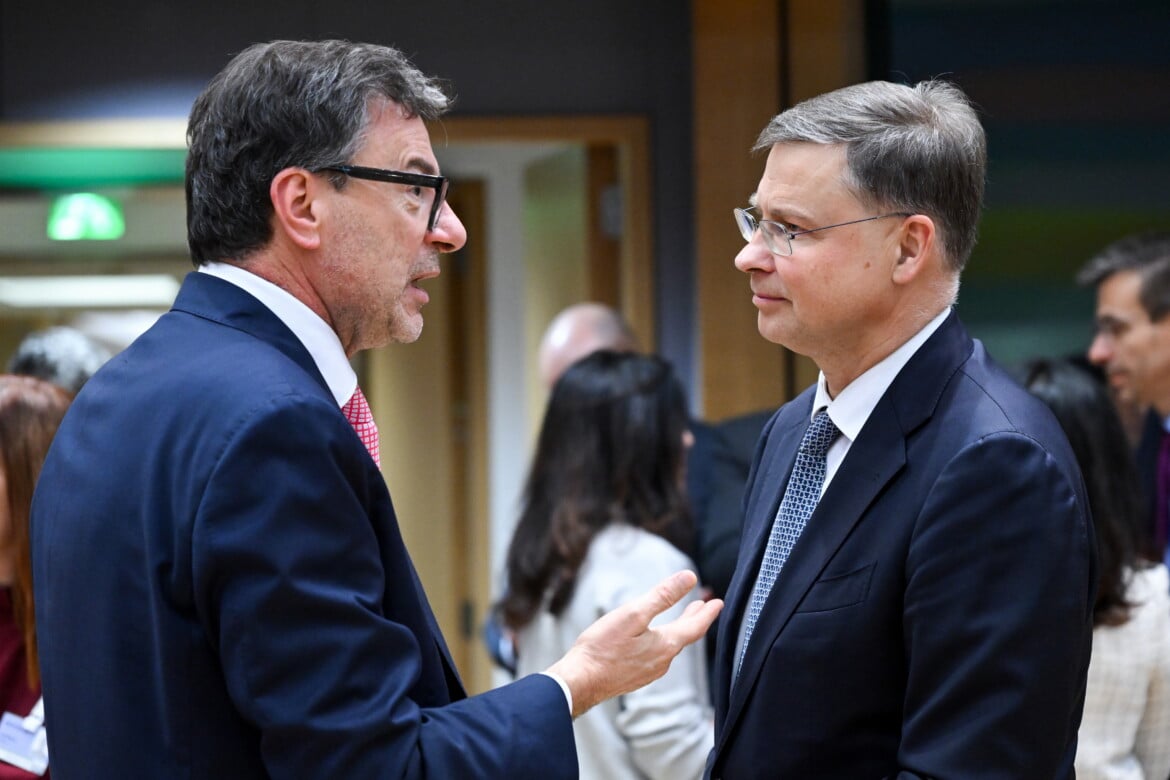
European Commissioner for the Economy Valdis Dombrovskis has once again dashed the Meloni government's hopes, reiterating on Thursday that the Stability and Growth Pact will not be “suspended” until there is a “severe economic downturn” caused by Donald Trump and Benjamin Netanyahu's war against Iran.
Regarding the taxation of windfall profits – requested by Italy alongside Germany, Spain, Portugal and Austria – Brussels opened the door to coordinated action, while wrongfooting the Italian government by pointing out it can always start by setting an example on its own, as every executive branch has the full authority to tax windfall profits independently. In doing so, the European Commission highlighted another sore spot for the Meloni government: Italy could have already taxed the excess margins in the energy and banking sectors, but it is using its support for the Europe-level initiative as cover to avoid having to deal with the intra-coalition conflicts between the Lega and Forza Italia over windfall profits.
Dombrovskis's response was significant because it arrived just after Prime Minister Giorgia Meloni had finished speaking in the lower house of Parliament during a briefing on the executive's actions – the speech in which Meloni officially called for the suspension of European budget rules, comparing the effects of the new war to the 2020 pandemic. Economy Minister Giancarlo Giorgetti reiterated the same stance on Thursday afternoon during question time in the Senate, adding that the government “will revise its growth estimates” and, in any case, he “believes in miracles.”
Giorgetti's quaint words are a cover for the hopes of a government that has realized it is in deep trouble due to the war unleashed by its “American friend” Trump. It dreams of the “miracle” of suspending the Stability Pact, akin to the measure adopted by Brussels after the outbreak of COVID-19. However, Dombrovskis recalled that the European economy remains exposed to the risk of a “stagflationary shock” and that growth could be 0.2 to 0.4 percentage points lower, while inflation could rise by up to one percentage point compared to autumn forecasts – a situation that is not yet comparable to a “severe economic downturn.”
Italy's GDP growth currently stands at 0.4 percent. Growth has halved, but it is not yet below zero. However, at this rate, and with the end of the National Recovery and Resilience Plan (NRRP), it could reach that point soon. Meloni and Giorgetti know this, and they want to avoid coming up to the 2027 elections having officially brought the country to its knees.
Even within the rules of very strict accounting austerity, there would be alternatives. Dombrovskis recalled that the “new” Stability Pact provides for “flexibility” that would render a blanket suspension unnecessary. The Stability Pact is calibrated on “net expenditure” and provides for so-called “automatic stabilizers” in the event of a revenue shortfall. The increase in interest spending on public debt and unemployment expenditures have been excluded from the calculation of deficit parameters.
All of this, however, is not enough for the Meloni government, which is asking to suspend the entire Stability Pact. This is proof that they find the situation alarming and that the economy is the hole that is undermining the government's victim-playing, nationalist narrative. The full extent of the nightmare situation of the public accounts will become clear in the coming days: on April 22, Eurostat will officially confirm whether the deficit is above or exactly at 3 percent of GDP; the EU Commission will communicate new economic estimates on May 21; and the verdict on exiting the excessive deficit procedure (the focal point of the government's entire agenda) will arrive on June 3. In the meantime, the government will continue to simmer over a low flame.
We must not forget that the request to suspend the Stability Pact is also tied to the need to increase defense spending as demanded by Trump and NATO (5 percent of GDP by 2035) and by Brussels (the “RearmEU” plan, now dubbed “Readiness 2030”). The government has no budgetary margins to respect these commitments and finance the war economy. Nor does it know if it will be able to activate the only exception to the Stability Pact currently available, i.e. for financing arms production. In other words, it is being pulled in a tug-of-war between the Atlantic Alliance (which is demanding money) and European rules (which forbid taking on debt).
This precarious dance is the comeuppance for the Meloni government, which signed the Stability Pact in 2023 without considering that the instrument was already inadequate back then because it imposes austerity on a global economy that produces periodic shocks and requires colossal investment spending. Furthermore, the Italian right is sweeping under the rug its responsibility for having signed another straitjacket for the country and thinks it has identified the ideal bogeyman for the upcoming elections in the very Stability Pact that it itself wanted.
Nonetheless, the difficulties that have the Meloni government in a chokehold today will be just as applicable to the opposition, if and when they come to power. This is not just the legacy Meloni leaves behind, but a political reality that will put a heavy mark on both life and politics in the coming years.
Originally published at https://ilmanifesto.it/governo-nella-morsa-tra-i-veti-di-bruxelles-e-le-armi-a-trump on 2026-04-10