
Interview
Lucía Topolansky on Pepe Mujica: ‘Our jungle was the concrete of the cities’
‘Today, nearly a year after Pepe’s death, it is incredible how much he is still present among the people. People loved him because he spoke simply, because he made himself understood and because he was close to the people.’
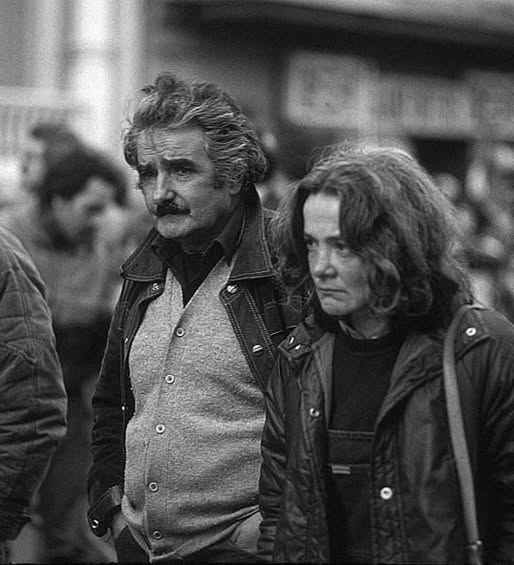
One year after his death we remember Pepe Mujica, the Tupamaro who became the poorest and most loved president in the world, with Lucía Topolansky, his companion in the fight and in life.
You and Pepe shared a life together. Which political choices best illustrate the shape of his particular path?
Uruguay is a small country that, at a certain point, began to experience a gradual economic decline, due in part to its heavy dependence on foreign markets and international reference prices. This process began at the end of the Korean War, around the late 1950s.
Until then, a model had developed based on import-substitution industrialization and a relatively high standard of living compared to the rest of Latin America, with progress in many areas. But that model quickly began to fall into crisis.
This generated a climate of growing social conflict. The impact of the Cuban Revolution on Latin America also fits into that same context. The continent had a long history of dictatorships widespread across most countries. The Cuban process pointed to a path – what was called the “armed path” – to achieve more quickly the changes deemed necessary to bring progress for the people.
A major debate then arose within the Latin American left: which path to follow, the electoral one or the armed one? Latin America tried both paths, persisted with both and in both cases met with defeat, because our northern neighbor instigated coups in every country, bringing an end to democracies.
It was in this context that the struggle of the National Liberation Movement, to which we belonged, arose. The movement set out to achieve exactly this: national liberation. That was the original cause.
We were defeated, we spent many years in prison and, having emerged from that ordeal, we entered institutional politics, legal politics, because before we had been outside the system. We did so with our cards on the table, without shortcuts, directly.
That was when we joined a coalition in which we were already taking part through other comrades: the Frente Amplio. Along that path we began to expand our political presence and, within that framework, we reached the point of Pepe’s election as president.
When did you begin to have contacts with Fidel Castro and the other leaders of the Cuban Revolution? After your release from prison or already during the clandestine phase?
The Cubans never agreed with our form of armed struggle, which was urban. In our country we have gently rolling terrain: there are no mountains or major geographical features. We used to say: where is our jungle? Our jungle is the concrete of the cities.
But the Cubans had had very negative experiences with urban armed struggle in their history, and for this reason they had always been opposed to it. So much so that in 1963, in Uruguay, at the beach resort of Punta del Este, a conference of the Organization of American States (OAS) was held, in which Ernesto Che Guevara participated as a delegate from Cuba.
After that conference, Guevara went to Montevideo and gave a very emblematic speech in the main auditorium of the University of the Republic. He was introduced by Salvador Allende, who would later become president of Chile through the electoral process before being overthrown by a coup d’état orchestrated from abroad.
At that conference Guevara said he was completely opposed to the urban armed struggle path in Uruguay. So on this point we did not agree with the Cubans.
Later, when our achievements became a concrete fact, the Cubans accepted it and there were also contacts between us. Some of our leaders participated in the conferences of OLAS, a continental coordinating body, and there were also exiles in Cuba, although most of our exiles were elsewhere.
How important – and how difficult – was it after the defeat and imprisonment to accept that the electoral path was one of the possible paths to change?
It was not easy, and not everyone in the Liberation Movement made the same choice we did. That struggle had enjoyed some support from the population, as polls at the time also showed, especially after allegations of corruption in Uruguayan politics and of very painful inequalities, particularly among some rural workers. Furthermore, that experience introduced new issues into the political debate.
But we suffered a military defeat. We had a huge number of people imprisoned. A group of comrades was taken hostage by the dictatorship: they were removed from the standard system for political prisoners and held in military barracks under extremely harsh conditions.
We had deaths and disappeared persons, although most of the Uruguayan disappeared were in Argentina, because Operation Condor was active in the Southern Cone countries, coordinating the dictatorships of Argentina, Uruguay, Brazil, Paraguay and Chile, and facilitating the exchange of people, information and everything else. We also had many exiles.
Jimmy Carter played a key role in bringing this phase to an end on the continent, as his presidency began to withdraw support from Latin American dictatorships. This left them, in a way, without backing. The dictatorships then began to look for off ramps, which varied from country to country.
In Uruguay there were lengthy negotiations. At first the dictatorship ended with some people still classed as outlaws, but that situation eventually got resolved. Today we have enjoyed more than 40 consecutive years of democracy since the end of the dictatorship.
We chose to fight within the law and started from scratch. We had to rebuild our relationship with our people, because after 12, almost 13 years in prison, the world and our country had changed.
So we decided to go out into the streets and squares to talk to people with an open microphone. We called those initiatives “mateadas,” because mate is our national drink, a Guaraní tradition, and it is shared in a circle. We shared mate while having a conversation with an open microphone.
People found it very exciting to be able to engage in dialogue that way and have the chance to express themselves, because Uruguay is a highly politicized country. So we began to receive support, joined the Frente Amplio and participated in the elections.
Our comrades decided that our first representative would be Pepe, along with another comrade, Eleuterio Fernández Huidobro, who has also passed away. Both entered parliament as deputies.
After all this, Pepe ends up becoming president and builds a message of peace and the rejection of hatred. Why?
Because you cannot look to the past and remain a prisoner of hatred.
Love and hate are two blind forces: love builds, hate destroys. We chose love and decided to build.
People understood this. And that is what led to the great popularity that Pepe still enjoys today, almost a year after his death.
We live in the rural area surrounding the capital, an area inhabited by simple people who grow vegetables and fruit, raise small animals and produce everything that ends up on families’ tables every day. We arrived here 40 years ago and began growing flowers.
At first we were “sapos de otro pozo” – outsiders – because it was a rather conservative neighborhood. Then, when they saw that Pepe became a deputy and did not leave, they were happy: there had never been a deputy living there before, and those who attained such a position usually left.
Then he became a senator and still stayed. Then a minister and still stayed. And when he became president and stayed there still, it was a great joy for them. Our home has always had its doors open. Neighbors could come by at any time.
For them, this represented the essence of the Republic, and we wanted to send exactly that signal. I believe we succeeded.
In Latin America, leaders often do not leave room for others. Mujica, on the other hand, worked to set up the right successor.
Uruguayan law does not allow for the immediate reelection of the president: one can be reelected, but only after skipping a term. Pepe also upheld a more general principle: the best leader is not the one who shines individually, but the one who leaves behind a group of comrades capable of replacing him under better conditions.
Politics is always collective. There are no people with a magic wand capable of doing everything on their own.
If only desert grows under a leader, when that leader disappears nothing remains. We have seen this many times in Latin American history.
People come and go, but causes remain. And someone must continue to carry them forward, because they are not realized in the short term: they require time, multiple generations. We must prepare the next generation, otherwise the process is interrupted.
What did Pepe think of the movements of the new century, such as the Sem Terra?
We have had – and still have – a very close relationship with the Landless Workers' Movement in Brazil. Brazil is a neighboring country, and we, being small and situated between two large countries, Brazil and Argentina, must always maintain good relations with our neighbors. Here we say that if Brazil or Argentina catch a cold, we catch the flu.
The Landless Workers' Movement seeks to offer those who want it the opportunity to work the land productively; it trains people and today has reached a very high level of productivity. It is an important example within Brazil.
In Uruguay, we have something similar with the National Institute of Colonization. Another important example for us was Neo-Zapatism. It made a deep impression on us and we followed it closely. It raised many questions for us, but we never managed to establish direct ties.
What remains of Pepe’s legacy today?
Today, nearly a year after Pepe’s death, it is incredible how much he is still present among the people. People loved him because he spoke simply, because he made himself understood and because he was close to the people.
Now we are working with our comrades to collect everything he wrote, the authentic materials, because today, with artificial intelligence, many falsehoods are circulating. We are building a space of memory, a place where people can go to think and reflect.
We found many notes written by him, including on current issues: for example, he had intuited what a second Trump administration would mean. We will organize all this material by theme – youth, agriculture, Latin American integration, worldview – because many universities and institutions have requested it from us.
We want to spread his ideas, because that is what truly remains. Our comrades will also organize activities for the anniversary, with music and other forms of expression.
Before he died, Pepe asked to stay home, to be allowed to die without pain and to scatter his ashes under a sequoia tree we have near our home. That is where we laid his ashes.
People come there, sit down and reflect. And we let everyone in, because we feel that place belongs to the people.
Can there be a future without capitalism?
We hope so. But we must be creative in building alternatives, because the ones tried so far have failed.
Originally published at https://ilmanifesto.it/lucia-topolansky-la-nostra-selva-era-il-cemento on 2026-05-13