
Report
Israel tortured me: I write not because this is exceptional but because it’s ordinary
Andrew Francisco, a US citizen, was captured by the Israeli navy on May 18 alongside more than 430 activists from the Global Sumud Flotilla.
About 46 hours had passed since our abduction when the masked woman with the megaphone appeared above us on the catwalk of our Israeli prison ship.
By that point, more than a few comrades had managed to peek out from beneath one of our makeshift dormitories and catch a glimpse of a long green strip of land. For two days we had read the sun like an omen, trying to figure out if they were taking us toward Egypt, Cyprus, Greece or Israel. South meant one kind of hope. North meant another. East meant something none of us wanted to say too loudly.
In the final hours of the journey, the ship was going unmistakably eastward. And yet, a part of us continued to hope that we were wrong. Then the woman looked down from her perch and announced: “Good morning, and welcome to Israel.”
A silent confirmation came with those words. Heads bowed. Some people's eyes filled with tears. We knew – or thought we knew – where they were taking us. But hearing it announced from above, in that almost cheerful tone, made the terror official.
There were more than 200 of us, crammed into an open-air steel rectangle. Six shipping containers had been arranged to create a prison yard on the ship’s deck. Razor wire crowned the top. A dozen portable toilets filled the empty space. Above us, masked soldiers patrolled with assault rifles. Two water cannons remained trained on us.
From a container beneath the bridge, our captors emerged with coffee and snacks, sitting on plastic chairs to watch us, photograph us and laugh, as if we were animals in a menagerie.
Through the megaphone, the masked woman told us the ship would soon dock in Ashdod. We would be taken away and subjected to immigration processing. She urged us to cooperate. Do not resist. Do not sing. Do not chant “Free Palestine.” Obey orders, she said, and no harm will come to you.
One of my comrades, Marco, an Italian activist of extraordinary courage and moral clarity, demanded that she give us her word. He wanted more than an instruction. He wanted a guarantee. She gave it to him. If we obeyed, she promised, we would not be harmed.
Some of us wanted to believe her. Ours was the “better” of the two prison ships carrying the 430 members of our flotilla toward an uncertain fate. “Better” is an obscene word to use, but it was true. On our ship, people had been beaten and maimed. We had been drenched in foul water. Our warm clothes had been taken from us. We had been forced to sleep exposed to the elements, crammed inside filthy containers on the ship’s deck, which flooded whenever the amphibious vessel submerged beyond a certain depth. We had been denied adequate food, water, sanitation, medical care and shelter.
But compared to our comrades on the other vessel, we had been spared. We had not all been beaten, repeatedly tased until we lost consciousness, or forced to listen hour after hour to the screams of people whose ribs and other bones had just been broken. This was the moral universe Israel had created: a place where being beaten, stripped, frozen, starved and locked up could still count as the “better” fate.
When the masked woman promised that obedience would protect us, some of us believed, or desperately wanted to believe, that a limit still existed.
We never saw her again.
After the Israeli sailors moored the ship, we were herded behind a line made with tape on the deck. Armed and armored men appeared in front of us, perhaps six feet away, with assault rifles and shotguns pointed at our faces. I was sitting cross-legged near the front row, with only one or two rows of people between me and these newly arrived men, even more heavily geared up than the others.
A soldier held a stack of passports and began calling out names. At first, the process seemed almost orderly. A name was called. The person stood up, collected their passport and disappeared through the open door into one of the containers. The first name called was that of a French woman whose thigh had been slashed open two days earlier. We clapped for her. We clapped for the others too, offering the smallest public gesture of courage to people walking into an unknown that we could not see.
The soldiers grew impatient. Maybe people were moving too slowly. Maybe the applause irritated them. Maybe nothing in particular was needed to set them off. The soldier holding the passports halted the process and ordered everyone out onto the deck of the ship.
As people exited the containers, he pointed to a slender, handsome, dark-skinned man – seemingly Arab, with a light beard and graying hair. Unlike those whose names had been called from the passports, he was not selected by a document or a procedure. He was selected with a gesture.
“You. Come here.”
When he came within reach, several soldiers grabbed him, shoved him through the open door and dragged him out of our sight.
Immediately afterward, we heard blood-curdling screams. They were not just cries of fear. It was the sound of animal suffering, of that man being brutalized beyond what we could even imagine from behind a thin sheet of metal.
For a second, the crowd did not understand what they were hearing. Then the realization hit us like a sledgehammer.
“Torture!”
“Stop!”
“Shame!”
People began to stand up. The protest had barely formed when a shotgun blast erupted from the line of soldiers toward the crowd.
I was about three feet away from Emir when I saw him buckle backward. I saw his face contort as he fell into the wave of bodies around him. Later, after our evacuation to Turkey, I saw the wound in his leg, the size of a two-euro coin – the exact same mark that so many comrades bore from rubber-coated steel bullets and similar ammunition. But in that moment, all I knew was that another dark-skinned man had been shot at close range.
Soldiers rushed into the crowd, grabbed Emir and dragged him away by his feet. He was screaming as they pulled him through that same open door, his voice fading into cries so piercing it sounded like the beating continued even as they carried him off the ship.
In that instant, everything changed.
We were no longer just miserable prisoners being denied food, water, shelter, medicine, sanitation and sleep. We realized that what awaited us beyond that threshold was organized, unprovoked, sadistic terror. Whatever rules we imagined still existed were gone.
The process resumed. The soldier called names from the passports. People stood up and stepped forward. But the applause had died down. Our visible solidarity retreated into smaller gestures: a look, a hand on a shoulder, a fleeting squeeze.
When my name was called, I looked for Abdessmad, a bald, thick-bearded, warm-hearted Moroccan man traveling on a French passport. We had met just a few days earlier in Marmaris when we were assigned to the same sailboat, the Josef. He spoke fluent French, German and Arabic, but only a little English. I spoke none of his languages. Captivity had made language less important. We understood each other the way people do when the only real conversation is survival.
During the interception two days prior, Abdessmad had been shot twice in the back in retaliation for throwing our cell phones into the sea so the commandos could not seize them. Even then, he had remained gentle and kind.
As I stood up, I touched his shoulder. He offered me the best broken, terrified and encouraging smile he could muster. I took my passport. Then I walked through the door.
Just beyond it, dozens of masked soldiers were waiting for us. They shoved my head down. They yanked me forward. They forced my hands behind my back and wrenched them upward, while shoving my neck and face toward the steel deck of the ship beneath me. The pain was immediate and sharp. I had already decided I was not going to scream. I clung to that decision with everything I had.
I did not stay on my feet for long. The soldiers bound my wrists with plastic zip ties as tightly as possible and carried me in a way that made me think my limbs might rip right off my torso. The pain took over so completely that time disappeared.
Somewhere in that fog, my captors hauled me off the boat and into a small, white-walled space on the ground that we would later dub “the torture tent.”
“What do you have on you?” a soldier screamed into my ear. “Nothing,” I swallowed. “I have nothing.”
The blows came fast: to the head, the arms, the legs, the chest. They dropped me, hauled me up, twisted me, yanked me. I was no longer a person capable of moving. I was a rag doll in the hands of men who seemed to take pleasure in finding new ways to inflict pain.
At one point, two soldiers forcibly spread my legs apart while another held me suspended in the air. They pulled so hard I thought my groin would tear. Through the pain and the violation, I realized this was supposed to be some kind of strip search.
Then came the final blow. It struck the right side of my ribcage, sharper and more deliberate than the rest. I cannot say if it was a kick or a punch. I only know the sensation of bone snapping beneath the skin – so clear, dry and violent that I could have sworn I heard it, like a branch snapping under a foot.
I am sure the soldier heard it too, because after that blow, the beating stopped. I was hauled back to my feet, dazed and barely conscious from the pain. The soldier leaned in close to my ear and whispered in English: “Welcome to Israel.”
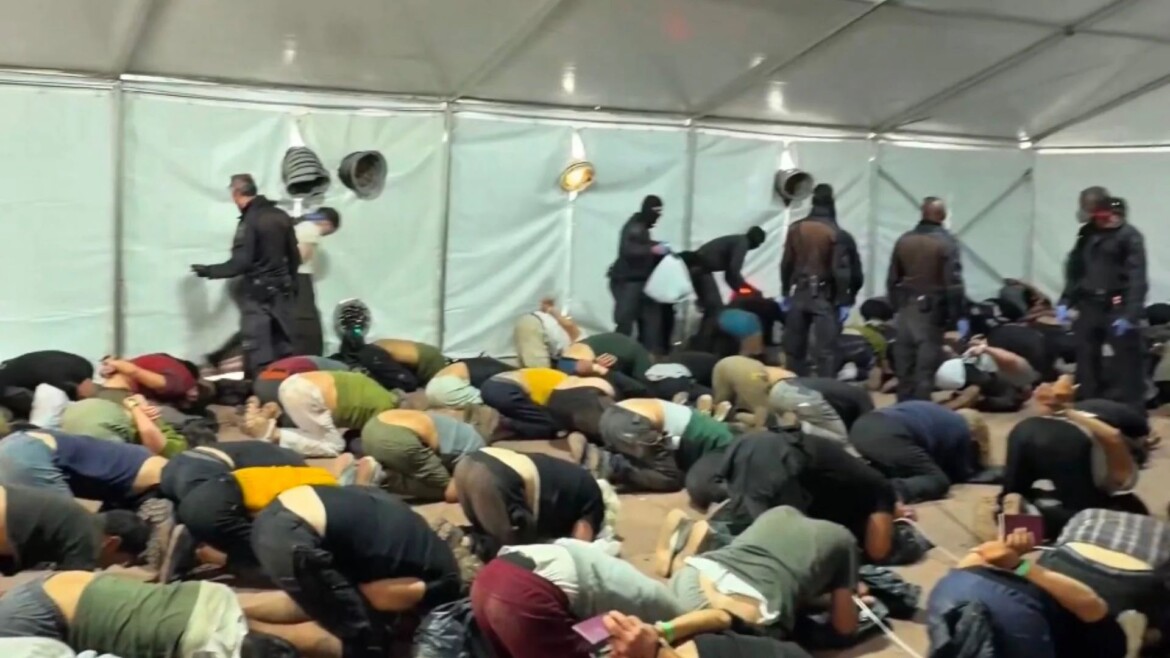
From there I was dragged into a much larger tent, where dozens of my comrades were already forced into the kneeling position that Israeli Security Minister Itamar Ben-Gvir would soon broadcast to the world. Somewhere between the ship and that tent, my plastic zip ties had snapped. During the beating, I had also lost my passport. I gasped something about it. Somehow, once I was on the ground, they handed it back to me.
I said, “Thank you.” I still do not understand it. I do not understand why, in those conditions, after being beaten and broken by the very apparatus that was now giving my passport back, a reflex of basic courtesy survived within me. Maybe domination teaches the body to feign gratitude for the smallest interruption of cruelty. Or maybe my passport still represented something I desperately needed to survive – something no amount of brutality could entirely strip of meaning.
Despite the confusion, I quickly realized how much of a gift those broken zip ties were. My hands were free. I could feel my fingers. I could twist the warped plastic so that, at first glance, it still looked like it was binding me. I could use my elbows to take some of the weight off my knees and my back.
Around me, others were not so lucky. After a while, my row was kicked toward the left side of the tent and pressed against another line of bodies. Screams continued from every direction, punctuating the siren-like wail of the Israeli national anthem playing on repeat. The women screamed in a different register – the sound of a deeper violation. I did not dare lift my head. I moved only my eyes and my neck just enough to see the bald head and the thick beard next to me.
It was Abdessmad.
His hands were bound behind his back with plastic zip ties. Because he could not use his elbows, he had to support his body weight with his forehead pressed against the rough, gravelly concrete. I could not look directly at his hands, but I caught enough glimpses of dark purple skin to know what was happening. His body had been forced into a position mathematically calculated to produce pure agony.
I thought I knew pain. Looking at him, I realized he was in a place far beyond anything I had experienced yet. This gentle man, my boatmate, my friend, the man whose shoulder I had touched before crossing the threshold, was folded into a torture posture just inches away from me. And there was nothing I could do.
I have spent my professional life as a public defender. I built my identity on standing beside people in cages, people brutalized by state power, people the world has chosen not to see. That calling is part of the reason I found myself on a flotilla, aboard a couple dozen dilapidated boats, defying the Israeli siege of Gaza.
It is part of the reason Palestine matters to me. But lying there next to Abdessmad, unable to free his hands or ease his pain, I felt the most absolute powerlessness I have ever known.
With the unearned gift of a free hand, I slid his passport toward his face.
“Lift your head,” I whispered. Our eyes met for a split second. “Andrew?” he said. “Please, Andrew, my hands.”
“What?” I whispered.
“Ask them to help me with my hands.”
He wanted me to call the guards. He was too terrified to do it himself. He knew, just as I did, that drawing the attention of those men was far more likely to bring pain than relief. But the agony in his hands had become so unbearable that he was asking me to take that risk.
I did not want to speak. Every survival instinct inside me demanded silence. But another part of me – the part I had spent my life believing was the core of who I am – could not refuse him.
When the next pair of combat boots entered my narrow field of vision, I forced the words out.
“Sir, please help this man. Please, help his hands.”
Silence. The boots marched past.
I tried again, a little louder.
“Please help his hands, sir. Please.”
Nothing. I waited for another pair of boots. “His hands,” I said again. “Please, help his hands.”
This time, I got their attention. A blow landed on the top of my head. “His hands,” I whimpered. “Help his hands.”
Then Abdessmad screamed with all the breath in his tortured lungs – a steady, high-pitched, unbroken scream. “His hands!” I shouted alongside him. “Somebody help his hands!”
Again, nothing.
“I'm sorry,” I finally gasped, fighting back tears. “I'm so sorry I can't help you.”
We stayed in that tent for maybe an hour, maybe longer. Eventually, Abdessmad was dragged away. By then, his screams had faded into a weak moan. My escort came to get me: a petite female soldier, skipping and giggling with glee at our misery, ready to guide me to the next phase of the process.
That expression matters: the next phase of the process. Because what happened next was not chaos. It was intake. It was bureaucracy. The torture tent, the kneeling tent, the strip-search tent, the immigration desks, the legal hearings, the prison transport, the holding cells, the consular visits, the deportation papers. Every stage had its own rituals and its own staff. Some were openly sadistic. Others were bored. Others play-acted legality over the screams, efficient and hollow.
But the machine never stopped moving.
A few hours later, after immigration processing in Ashdod and before the horrors that awaited us at Ktzi'ot prison, I saw Abdessmad again inside a crowded armored transport. Eighteen of us were crammed into a tiny cell, our hands and legs now locked in heavy steel shackles. His forehead was visibly scraped raw and bleeding. He recognized me instantly. And then he smiled.
In his limited English, Abdessmad told the people around us that I had helped him. It nearly broke me. I had done next to nothing. I had slid a passport under his head. I had begged the men who beat me to loosen his hands. I had failed. And yet here he was, still in agony, thanking me for a gesture so small it felt unworthy of his gratitude.
In that moment I knew, without a shadow of a doubt, that he would have done the exact same thing for me. This is solidarity: not a slogan, not a chant, not a performance of courage, but the decision to remain responsible for one another even when that responsibility has been rendered nearly impossible. Abdessmad reminded me why I was there. He gave me enough strength to face what was coming next.
Inside that prison transport, there were messages carved into the walls, scratched in Arabic by the people who had been in that cage before us. I could not read them. But I knew what they meant.
We were not the first people transported like that, and we were not the people that machine was built for. We were mostly white international volunteers from the Global North, people with solid credentials and governments that, eventually, could be embarrassed into caring. We were temporary passengers. We were getting a watered-down version – shielded by our passports – of the treatment reserved for Palestinians.
The walls already knew the people for whom that machine had been built.
That was where the heaviest truth settled over me. Our passports had not protected us from being beaten. They had not protected us from sexual humiliation, from broken bones, from terror or from the sadistic pleasure of our captors. But they had protected us with the one thing Palestinians are so often denied: a way out.
This is why I am writing. Not because what happened to us is exceptional, but because it is ordinary. Israeli leaders and their defenders have tried to make Ben-Gvir the central character of the story. But Ben-Gvir did not build the machine that held us captive. He did not invent the cages, the stress positions, the strip searches, the sexual humiliation, the chains, the beatings, the performative hearings or the bureaucratic cruelty that pushed us from one stage to the next. He just did what men like him do. He celebrated it. He filmed it. He turned our suffering into a spectacle.
But the machine was already there. It was there before we arrived in Ashdod, before our flotilla ever set sail from Marmaris, before Ben-Gvir loomed over our bound, kneeling bodies and taunted us for his cameras. What we experienced was not a deviation from the system. It was the system, briefly turned against people whose passports made the violence harder for Western governments to ignore.
For 78 hours, Israeli forces treated us with a level of cruelty many of us never imagined we would experience firsthand. And yet, we were protected. It does not feel true in my ribs. It does not feel true when I remember Abdessmad’s hands, Emir’s face, the screams behind the metal wall, or the comrades whose injuries should bring deep shame to every government that continues to arm and protect Israel.
But it is true. We were protected because our governments knew our names, because journalists were asking questions, because lawyers were standing by, because our passports remained – however imperfectly – a claim on the attention of states that would prefer not to see us but cannot pretend we do not exist.
The men and women whose messages in Arabic were scratched into the walls of that prison transport were not temporary passengers of the machine, on their way to consular visits and deportation flights. They were the machine’s designated targets – the people for whom the cages, the chains, the stress positions, the interrogations, the humiliations and the legal fictions were built in the first place.
I write because I felt them. Not directly, not fully, not enough. But I felt their echo in that transport. I saw them on the prison walls. I saw them in the murals at Ktzi'ot, where images of destruction were displayed like trophies, where cityscapes were reduced to rubble beneath captions in Arabic announcing “The New Gaza.” I saw them in the special brand of brutality directed at our Arab, Muslim, Black, brown and Asian comrades.
Western governments cannot respond by merely expressing concern, accepting Israel’s reassurances and moving on. They cannot pretend that Ben-Gvir is the anomaly while continuing to arm, fund, justify and diplomatically shield the state apparatus he helps administer. They cannot condemn the spectacle while preserving the system that made the spectacle possible.
The demand cannot just be that internationals get treated better next time. The Israeli prison system must be opened to independent international inspections. Allegations of torture, sexual violence, racialized abuse, the denial of medical care and deaths in custody must be investigated as crimes, not managed as PR problems.
There must be accountability for the torture of the flotilla activists. But if accountability stops with us, it will only reproduce the exact same hierarchy that allowed this system to thrive in the first place. Our suffering matters because all suffering matters. It does not matter more simply because we are Westerners, internationals or hold powerful passports.
The central demand must remain Palestinian liberation: an end to the siege on Gaza, freedom for Palestinian prisoners and an end to the carceral architecture of domination over Palestinian life.
We thought our passports would protect us. We were not wrong.
They protected us. They protected us from staying there permanently. They protected us from disappearing. They protected us from being swallowed whole.
The Palestinians deserve more than a witness who passed briefly through the machine and survived to describe it firsthand.
They deserve to be free.
Originally published at https://ilmanifesto.it/nelle-celle-di-israele-neanche-la-violenza-e-uguale-per-tutti on 2026-05-27