
Commentary
Hollywood-style shootout brings more conflict to an exhausted nation
The divided reaction to the attack is a snapshot of the deep, calcified rift across the country, along with the deliberate, exploitative claim of “fake news” that has rendered a shared reality impossible to reach.
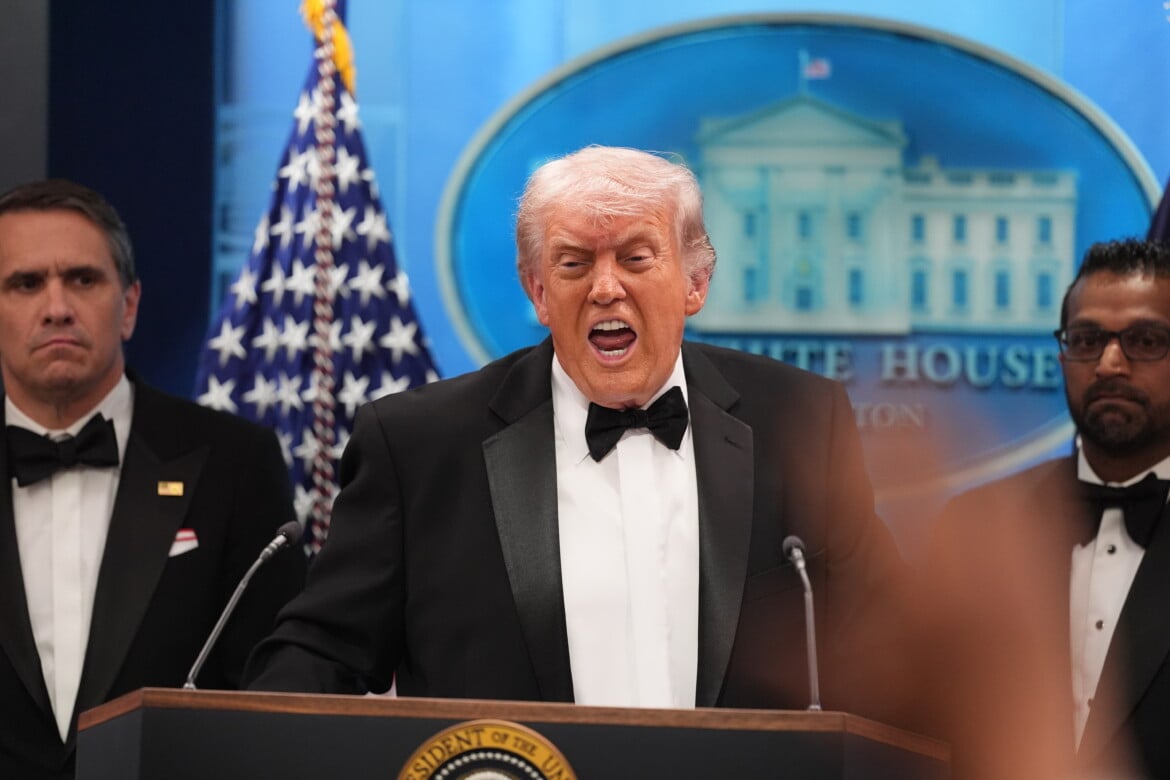
Saturday night’s attack resulted in scenes straight out of a movie. For some, it brought to mind Wolfgang Petersen’s In the Line of Fire, in which Clint Eastwood tracks down John Malkovich, the would-be presidential assassin, in a large hotel.
It is not just that Cole Tomas Allen apparently tried to imitate that exact scenario. There was also the drama of the preparation, the cross-country train journey and the suspense of checking into the hotel with an army of security personnel patrolling the perimeter but neglecting to keep an eye on the guests. The finale featured breathtaking action and a climactic scene in the VIP section.
The genre is familiar: an assassination plot made in the USA. But we are no longer in the 1980s, so the genre immediately shifted from an action thriller to a political dystopia where the line between facts and assumptions becomes blurred.
It is a script that Hollywood might call a bit dense and arcane, but symptomatic of the current political era. The reception hall hadn’t yet been fully evacuated when posts from skeptics began flooding the internet about it all being a blatant setup. Or, if not that, a real attacker intentionally left alone until the very last moment by the intelligence services, who supposedly knew about it but decided to capitalize on the resulting boost in the president’s approval ratings.
It is impossible to completely refute these scenarios. It is extraordinary, however, that an event that took place on live stream and under the watchful eyes of a thousand of the country’s most prominent journalists could have immediately given rise to such diametrically opposed interpretations.
The two previous assassination attempts against Trump did not help in terms of curbing the proliferation of conspiracy theories: the one in July 2024, in Butler, Pennsylvania during the campaign, and then the (narrowly avoided) one in September 2024 on a golf course in Florida. Both were “normalized” to an extent by Trump’s brand of communications (especially the first, which was recycled into a campaign ad and then completely shelved and relegated to oblivion – to the point of failing to persuade even a significant portion of the MAGA base).
This time, the “coincidences” also included the comments made immediately before the shooting by White House Press Secretary Karoline Leavitt, who said “there will be some shots fired” that evening – just a common expression for verbal jabs, or was it? It was inevitable that for half of the American public, this amounted to pouring fuel on the fire of doubt.
At the briefing held immediately after the incident, Trump discussed the repeated attempts on his life in his inimitable style, turning them into a boast: “Well, you know, I've studied assassinations and I must tell you the most impactful people, the people that do the most, you take a look at Abraham Lincoln... The people that make the biggest impact, they’re the ones that they go after ... Just take a look at the names here, the big names … And I hate to say I'm honored by that, but I've done a lot.”
Along with the tuxedos and evening gowns worn by the high officials and journalists who had just been evacuated – which lent a surreal atmosphere reminiscent of an Oscars press room – the statement conveyed a paradoxical sense of normalization, as if what was being discussed was a newly awarded film, or a FIFA trophy for the best assassination attempt.
The goodwill that, for a moment, seemed to unite the press and the regime for once as participants in a shared trauma lasted less than 24 hours. The next day, Trump responded to a question from Norah O’Donnell on 60 Minutes who asked him about the attacker’s “manifesto,” reading out the statement: “I am no longer willing to permit a pedophile, rapist, and traitor to coat my hands with his crimes.” Trump replied: “I was waiting for you to read that because I knew you would, because you’re horrible people. Horrible people … I’m not a rapist. I didn’t rape anybody. I’m not a pedophile ... I was totally exonerated … You shouldn't be reading that on 60 Minutes. You're a disgrace. But go ahead. Let's finish the interview.”
Here was Trump again, bitter and resentful – the president’s trademark. And the casually hurled insult is emblematic of the mood that Trumpism has brought to an exhausted country, which is paying the price for ten years of conflict methodically injected into discourse and public life, of governance as bullying.
The daily exasperation that all this is causing for millions of people is palpable, and the growing sense of helplessness objectively mirrors that expressed by the attacker in his letter to his family – a partial explanation for the outrageous actions of the mild-mannered computer engineer, Caltech graduate and model teacher.
That reality cannot be attributed – as the regime is predictably claiming – to a “violent left” that has supposedly “poisoned the nation” with its anti-Trump rhetoric, but rather to an exhausted country, worn down by the relentless and all-encompassing assault on democracy (which truly is poisonous), the blatant corruption of unchecked autocracy and injustice elevated to the level of politics and geopolitics.
The divided reaction to the attack is a snapshot of the deep, calcified rift across the country, along with the deliberate, exploitative claim of “fake news” that has rendered a shared reality impossible to reach. This is the degradation of democracy characteristic of epochal historical shifts, totalitarian ascents and Sarajevos.
Whatever the fate of Trumpism may be in the coming months or years, the work to reestablish the minimal foundations for a democracy, for a functioning nation, will be arduous and will inevitably take years or decades. At this point, the only thing that is clear is that many bridges have been burned. The epochal shift for the worse is already done.
Originally published at https://ilmanifesto.it/le-iniezioni-di-conflitto-in-un-paese-stremato on 2026-04-28