
Analysis
Hannoun arrest order shows Israeli logic has entered the Italian justice system
Hannoun is no longer being accused of merely supporting his contacts but of nothing less than being the “head of the Italian cell” of Hamas.
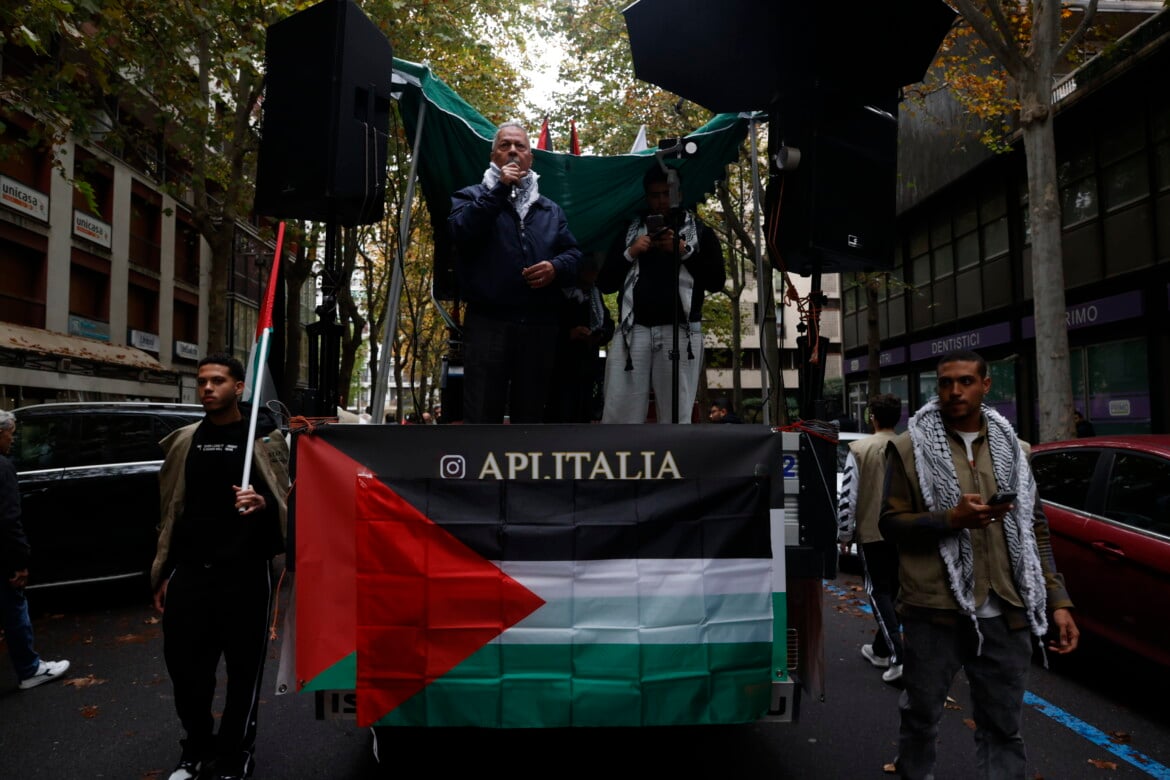
Mohammad Hannoun, the leader of the Association of Palestinians in Italy – 64 years old, a resident of Genoa since 1983 – was arrested only on Saturday, after he had been known to authorities since at least 1991.
The first DIGOS (Special Operations Division) report mentioning his contacts with the then-nascent Hamas dates back 35 years. The issue has already been examined twice by the court of Genoa (in 2006 and 2010); in both cases, the investigations against Hannoun – which, like this latest one, started from the assumption that collecting donations in solidarity is actually a front for subsidizing armed struggle – ended with no charges of any kind: the first one after the ruling of a judge and the second at the request of the prosecutor’s office itself, which deemed that the evidence did not justify going to trial.
Now, however, things have changed: Hannoun is no longer being accused of merely supporting his contacts – some of whom may be dangerous, but which have certainly been known for decades – but of nothing less than being the “head of the Italian cell” of Hamas.
The fact is that since the attacks of October 7, 2023, the perception of many NGOs operating in the Gaza Strip has changed. Since that date, Israeli authorities have blacklisted as terrorist organizations many entities that have worked in the area for decades. This includes those that have been targeted by the investigation begun at the end of 2023 at the behest of the National Anti-Mafia Directorate (DNA) and which culminated on Saturday with “Operation Domino” ordered by the District Anti-Mafia Directorate (DDA) of Genoa: 6 arrests (including Hannoun), 25 suspects under investigation but not detained, and two wanted persons whose whereabouts are unknown.
In March 2006, Hannoun’s situation was evaluated by Preliminary Investigation Judge (GIP) Maurizio De Matteis, who rejected an arrest request by then-deputy prosecutor Nicola Piacente (today chief prosecutor of Genoa). He wrote that while “a certain sharing of the ideals of the organization in question” on the part of the suspect “is apparent from the investigation documents”, “encounters and manifestations of sympathy toward Hamas have little evidentiary validity” – also because “it is not surprising that militants for the Palestinian cause meet with figures who are part of the most important Palestinian group.” It must be kept in mind that this took place after Hamas’ electoral victory. In any case, beyond telephone intercepts showing “a certain sharing of … ideals” as mentioned above, the investigation had failed to find “serious indications” of any direct financing of armed struggle activities. And the conduct involved back then was in all respects identical to that which led to the recent judicial blitz.
Now, Judge Carpanini has dedicated dozens of pages of her order to reconstructing the history of Hamas, concluding that the “political wing” and the “military wing” are one and the same and that, therefore, dealing with the former is equivalent to dealing with the latter. For this reason, it doesn’t matter if the prosecutors haven’t discovered orders or operational plans directly linking the seized funds to any armed groups or violent acts. This has a lot to do with the paradigm shift that came after October 7, 2023: Israel began treating NGOs in the Strip (and not only) on par with terrorist organizations, exploiting the fact that working in Gaza inevitably means having to deal with Hamas, which fully controls all the institutions there. Setting up any form of judicial cooperation with Tel Aviv means accepting this view of things: that Palestinians – and those who help them – are all terrorists.
This is why, since the end of 2023, Hannoun has seen his personal bank accounts (and those of his associations) closed by decisions of the banks hosting them, precisely because they were deemed sources of funds for Hamas. This explains, in any case, the large amounts of cash seized by the police and the Finance Guard, as well as the activist’s frequent trips to Turkey to deposit these funds (over 8 million euros confiscated in total).
In order to claim that the NGOs under investigation together with Hannoun are linked to Hamas, the judge refers to documentation transmitted via letters rogatory from Tel Aviv five times between 2003 and 2005, and to other documents provided “at its own initiative by the competent authority of Israel on July 1 and August 21, 2025.” This refers to information from Israeli intelligence claiming that various associations and entities – including those targeted in the current investigation – are nothing more than “hubs for the financing of Hamas.”
Here, the decision signed in January 2010 by prosecutor Francesca Nanni makes the crucial point: in asking for the dismissal of a terrorism file involving Hannoun, she wrote of the “difficulty, in some cases impossibility, of using material transmitted by Israel, often collected as part of actual military operations, moreover without the observance of the fundamental principles regulating the acquisition of evidence in our legal system.” After all, in a state governed by the rule of law, one should not take as gospel whatever comes from the military apparatus of a country at war.
On Wednesday, Hannoun was set to be questioned by the Genoa GIP. According to his legal team, he would not be answering questions – “We haven’t received all the filed documents yet,” say his lawyers Fabio Sommovigo and Emanuele Tambuscio, who met with him on Tuesday in Marassi prison – but he would offer voluntary statements to the effect that he can demonstrate the destination of all funds collected over the years, which have always been destined for civilian organizations and never military ones. The evidence proving this, however, seems to have already been seized and thus, paradoxically, is available to the investigators but not the defenders.
Given the nature of the accusations, it was unlikely that anything would change regarding his preventive detention. In that regard, the crucial decision is set to come from the Review Court, not before the end of January.
Originally published at https://ilmanifesto.it/hannoun-il-teorema-israeliano-nelle-carte-della-procura on 2025-12-30