
Interview
Free DC: ‘Voting may not be enough – we must mobilize en masse’
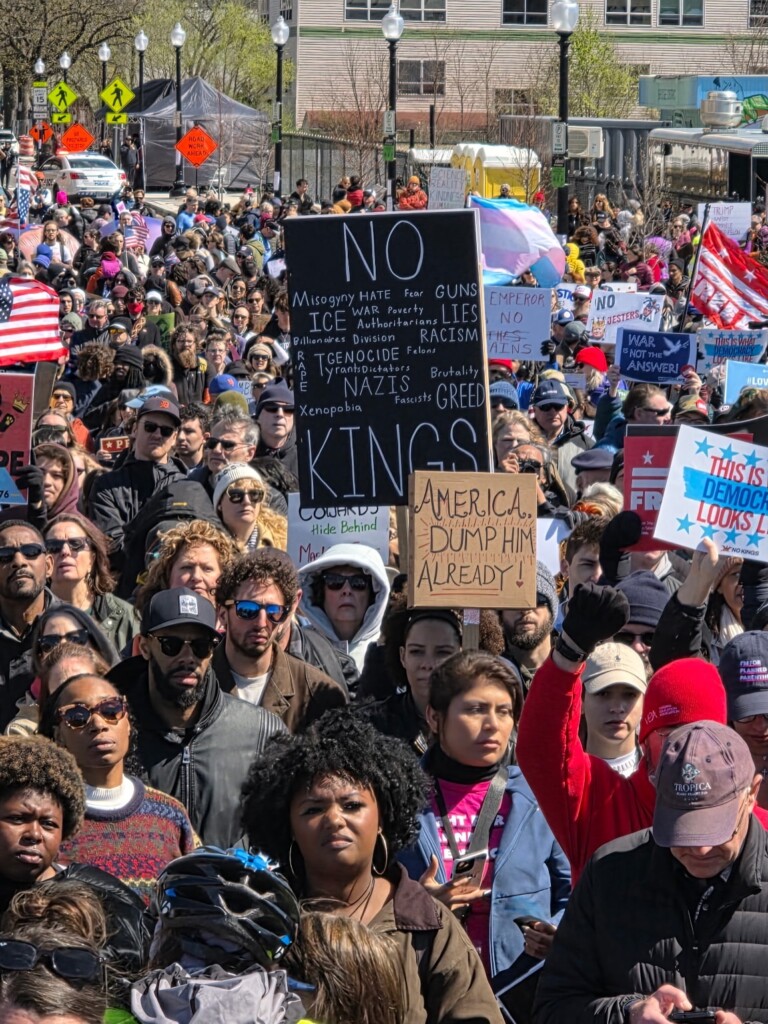
In America, the growing resistance to Trump and his ICE agents: ‘Those who come to the meetings are often ready to act. Those who are angry need to be guided toward constructive action.’
Emilia, coordinator of Free DC, welcomes us with a smile, as do Reverend Scott Bostic and Slobodan Milic, both of them non-cooperation trainers.
“The training sessions,” Emilia says, “serve to introduce the tools that have done their part in challenging authoritarian movements. In refusing to participate in a system that denies rights and treats certain people as second-class citizens. The main difficulty is finding a space; getting people involved is not an issue. Many are active and outraged by what is happening.”
As she explains, attendance grows when events occur that spark anger and drops when the situation calms down, but there is always a core group that remains involved regardless of these ups and downs.
Bostic is a pastor in the United Methodist Church and a former soldier with 10 years of service who deployed to Iraq and from there worked out a path toward nonviolence. Milic comes from Odpor, the Serbian nonviolent movement against Slobodan Milosevic.
How did your activism with Free DC begin?
Scott Bostic: I was not new to protests; for example, in 2017 I attended the Women’s March. In January 2025 I started working with Free DC, but I had already started becoming active when it became clear that Trump was likely going to be re-elected. Meetings and training sessions had started to figure out how to organize a response.
Slobodan Milic: After Odpor in the 90s, I have been supporting political and civil movements all over the world against authoritarian regimes for over 25 years.
Do you see a difference between the protests of 2017 and those of today?
SB: During the first term there were large protests, but it was not a continuous resistance. Today we are perhaps more consistent and more effective at mobilizing people. And we have learned that the symbolic action of taking to the streets is not enough. Voting probably will not be enough either: it will be necessary to defend the election results and mobilize en masse.
Are you also training people on how to deal with ICE at the polling stations?
SM: The voting system here is different from Europe; voting takes place over several days, including by mail. ICE will be an issue, but less of a determining factor than in a system concentrated into a single day. Nevertheless, it’s difficult to deal with masked agents who hold a lot of power.
SB: The goal is to make people feel safe. One needs to have a voting plan – whether it is early, by mail or in person – and it is primarily about safety. We are seeing less participation, for example, among Hispanic families who are avoiding registering to vote.
How can people defend themselves against the agents?
SB: We need to accompany vulnerable people and document everything. Documentation is key: it can make agents back off, but when they want to arrest someone they act quickly and it is difficult to intervene.
SM: In the neighborhoods we have rapid response teams with specific roles. Someone who talks to the person being stopped, someone who records and someone who interacts with the police. We have also obtained access to local police bodycam footage. This is a small but important step that can make a difference in trials, since ICE agents do not wear bodycams.
Is there more anger or fear right now?
SB: There are different reactions, a bit like in the stages of grief: anger, shock, depression, denial and acceptance. Those who come to the meetings are often ready to act. Those who are angry need to be guided toward constructive action.
Reverend, how are you handling all of this on a personal level?
I pray a lot and seek out moments for myself in nature. It is a space that reminds me of the good that exists in the world. And then seeing people become aware of their own power and take action is a great source of hope. Same with seeing young people get involved. They listen more than we think. I have a daughter: I tell her to clear the table and she doesn’t listen, then she recites the principles of de-escalation to me. I am a Black man in the United States; for me, there is a real risk in speaking out, but I want to help build a more just world for my daughter and for everyone. I was willing to risk my life when taking part in violence abroad; I must be willing to do so here too through nonviolence.
Originally published at https://ilmanifesto.it/free-dc-scendere-in-piazza-non-basta-serve-una-mobilitazione-di-massa on 2026-04-23