
Report
Flotilla activists Thiago Ávila and Saif Abu Keshek released from Israeli prison
The arrest of the Brazilian Ávila and the Spanish-Palestinian Abu Keshek took place 1,000 kilometers from Israeli territorial waters and no formal charges were ever brought against the two.
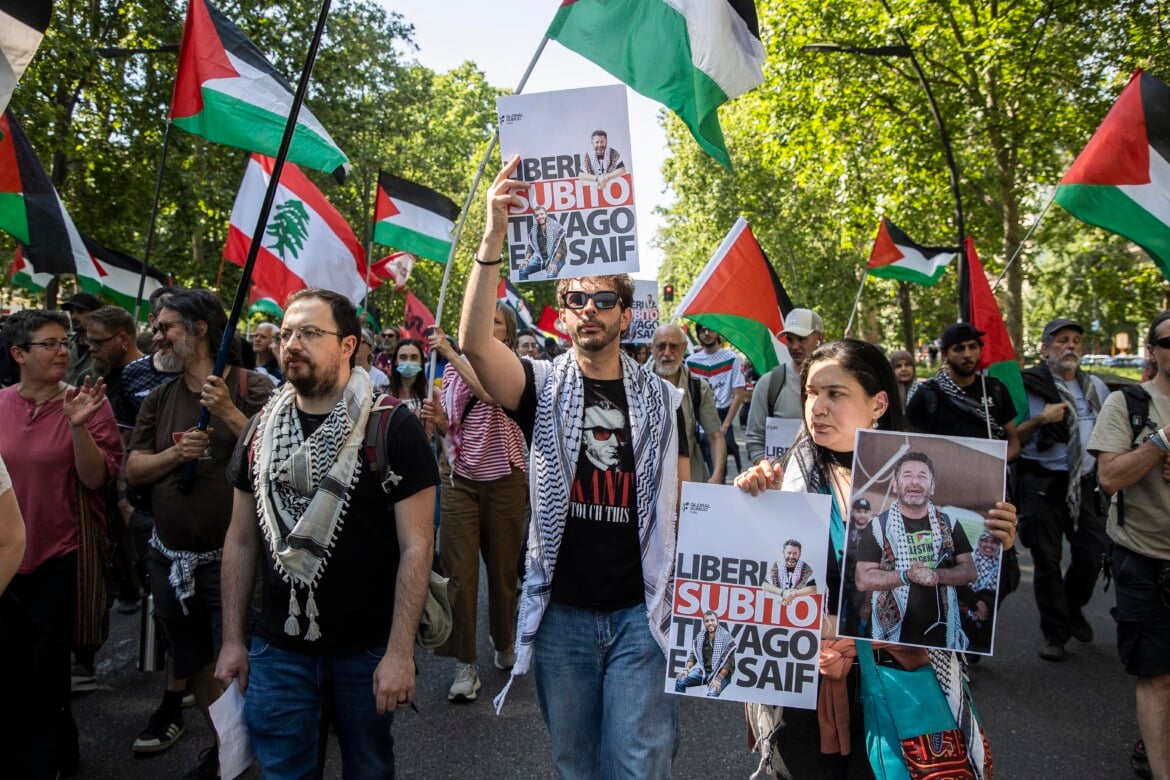
Ten days after being seized by Israeli soldiers in international waters while aboard an Italian-flagged ship of the Global Sumud Flotilla, Thiago Ávila and Saif Abu Keshek were set to be moved from the Ashkelon prison to a deportation center and sent back to their home countries, perhaps as early as Sunday. As of Saturday night authorities in Tel Aviv had not officially announced the news, but on Saturday morning the Shabak (Israel’s internal intelligence agency) communicated the decision to the NGO Adalah, which has offered its legal support to the two Flotilla members throughout their entire detention period.
Further confirmation came from Spanish Foreign Minister José Manuel Albares, who informed Sally Issa, Abu Keshek’s wife, of his imminent release. The breakthrough came after several appeals against an act whose arbitrariness was immediately obvious. There was significant pressure on Israel from various sides including the UN; in practice, however, this was fully in line with Israel's modus operandi in such situations: short detentions and no actual trial. Reasons of expediency ultimately prevail: the detainees bring many diplomatic problems in exchange for no clear advantage.
“We welcome this news as a victory for popular mobilization and the constant pressure exerted all over the world in recent days,” Sumud stated. “But we will not stop rising up until Saif and Thiago are finally home, safe and sound.”
The deportation will likely take place through the Taba border crossing in Egypt. From there, flights will be organized for their return home. Right now, both the legal team of the humanitarian expedition and the governments of the home countries of the two detainees are working on their return. “We will continue to demand explanations from the European Union for what happened,” the Flotilla further stated, “and immediate sanctions against Israel for this illegal kidnapping and for the continuous violations of international law and the human rights of the Palestinian people.”
The arrest of the Brazilian Ávila and the Spanish-Palestinian Abu Keshek took place 1,000 kilometers from Israeli territorial waters and no formal charges were ever brought against the two, even though there was talk of crimes such as “aiding the enemy in wartime,” “membership in a terrorist organization,” “aiding a terrorist organization” and “contact with a foreign agent.” During the hearings at the Be'er Sheva court (the last of which was scheduled for Saturday morning but would not be held), however, the documents relating to the charges were classified and Adalah's lawyers were unable to review them. In protest, the prisoners began a hunger strike from the moment of their arrest, and Abu Keshek decided to stop drinking water during the final round in court on Thursday after the guards refused to bring him water in the courtroom despite his lawyer's repeated requests.
Furthermore, the conditions of their detention were quite harsh. According to what they told their lawyers, Ávila and Abu Keshek were kept the entire time in freezing cells with the lights on 24 hours a day. From time to time they were interrogated by the Shabak, which wanted information on the Flotilla’s activities. Strong protests over Israel’s conduct came from both Spain and Brazil. Minister Albares summoned the chargé d’affaires of Tel Aviv in Madrid two times to demand the immediate release of the arrested men, while Brazilian President Luiz Inácio Lula da Silva spoke of an “unjustifiable detention” and a “serious violation of international law.”
Much less vehement reactions came from Italy, where the Rome prosecutor's office has nonetheless opened an investigation for kidnapping. Prosecutors Lucia Lotti and Stefano Opilio are also proceeding with the case of what happened to the Flotilla last October, which was also intercepted by Israel. In that case, the alleged crimes are torture, kidnapping, robbery and causing damage with the risk of shipwreck. The translated documents from that investigation have finally arrived at the Ministry of Justice, which will now have to decide whether or not to forward the letters rogatory to Israel in search of unlikely judicial cooperation to find out the names of the soldiers who took part and who should be entered into the register of suspects.
For this reason, the Flotilla is demanding “clarity from the Italian government regarding the events in international waters and on boats flying the Italian flag, to ascertain all those responsible and to take an immediate and clear stance for the suspension of agreements with Israel.” No one in the government appears willing to take such a step and their lips are sealed, including regarding the letters rogatory requested by the Rome prosecutor's office. The Ministry of Justice has the power to block them if it deems them a risk to national security. Therefore, whether the investigation moves forward or not will be a political decision.
Originally published at https://ilmanifesto.it/thiago-e-saif-escono-di-prigione-saranno-espulsi-da-israele on 2026-05-10