
Interview
Federico Finchelstein: The aspiring fascists among us
Trump’s ‘most lasting influence – including beyond the borders of his country – will be a global normalization of wannabe fascists.’
The formula of “studying the past to understand the present,” at first glance overused, has a unique relevance when dealing with the cultures of the extreme right. Not so much because what happened in the past might manifest again in the same form today or in the near future, but rather because the analyses and historical research that investigated those events can be useful for interpreting new phenomena – building up, step by step, an interpretation that would be adequate for the times and the new challenges we are forced to face.
This has long been one of the guiding lines of the research carried out by Argentine historian Federico Finchelstein, professor at the New School for Social Research in New York. Volume by volume, he is tracing a complete map of the trajectories taken by anti-democratic and reactionary political cultures throughout the entire 20th century, passing through European fascisms and Latin American dictatorships up to current developments.
Among his books are From Fascism to Populism (2019), A Brief History of Fascist Lies (2020) and Fascist Mythologies (2022), all published in Italian translations by Donzelli, and those still unpublished in Italy on the Argentine dictatorship and the relationships between Italian fascism and Buenos Aires.
This path leads to Finchelstein’s latest work, The Wannabe Fascists: A Guide to Understanding the Greatest Threat to Democracy (translated in Italian as Aspiranti fascisti, with preface by Nadia Urbinati, translation by David Scaffei, ed. Donzelli, 248 pp., €19). The historian presented the book on Sunday in Rome at the Più libri più liberi fair with Marco Damilano.
At the center of the book are what Finchelstein calls “wannabe fascists” – the protagonists of that global phenomenon in which right-wing populists set off toward the conquest of power in many countries of the global North and South, with the objective, often openly declared, of changing the very face of the democratic systems that allowed their emergence. The threat, explains Finchelstein, lies in the forms that this authoritarian, nationalist and racist turn – already extremely dangerous in its current manifestations – could assume until it completely destroys democracy.
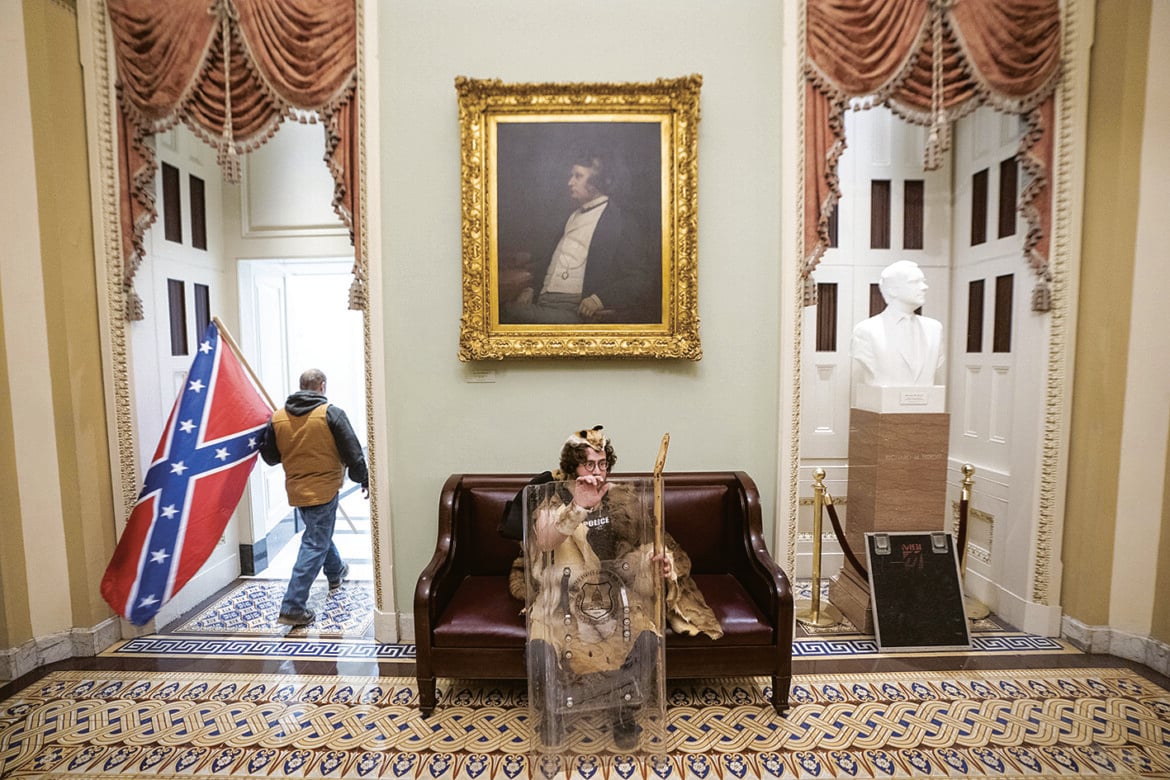
Every day, populists threaten guarantees and rules everywhere. And in Washington in 2021, they attempted a coup d'état.
“The Wannabe Fascists” completes the analysis of right-wing populism that you started with your previous works. So, before defining this phenomenon, we need to understand how we got here.
In effect, I believe we can define the “wannabe fascists” starting from the history that preceded them – that of fascism and populism. In my analysis, (right-wing) populism appeared after 1945 as a sort of reformulation of fascism, of the third way between communism and liberalism, but in a democratic, electoral form. It is a phenomenon that emerged first in Latin America with figures like Juan Domingo Perón in Argentina or Getúlio Vargas in Brazil. Forms tending toward authoritarian democracy could be seen elsewhere too, as in post-war Italy with the Uomo Qualunque movement. Thus, in the field of anti-democratic, anti-liberal and anti-left authoritarianism, the place previously occupied by fascism would be taken for many decades by right-wing populism – a phenomenon that operates within democratic rules, albeit trying to weaken them. All this along a wide temporal arc that we imagine going from Perón up to Berlusconi.
But then, in your view, things changed and we went from populists to wannabe fascists?
Certainly. Because in the 21st century a new form of populism appeared which, unlike the previous one, is no longer interested in maintaining the rules of the democratic game – despite all the attempts to control them that we have already seen. It is this new trend I explore in the book: leaders and movements pushing in the direction of features that are no longer those of populism, but rather of fascism itself. This is why I speak of “wannabe fascists” or “incomplete fascists.” They do not openly support fascism, but they proceed toward fascist-style political modes and behaviors, embodying a dangerous threat to democracy.
To measure the degree of this drift, you invoke four key elements of fascism.
Indeed. To try to understand if we are still talking about populism or if we are already in fascism, I try to read the trajectories of these leaders and movements through the lens of what I consider the four pillars of fascism: violence and the militarization of politics, lies and propaganda, xenophobia and racism, and finally, dictatorship. And it seems to me that the first three are already fully operational in many political contexts: today only the fourth is missing. However, I don't believe we can speak of fascism in the absence of all these characteristics. Populism can tend toward authoritarianism, but within a democratic system. Whereas a dictatorship is possible without fascism, but not the reverse: there is no fascism without dictatorship.
Regarding the spread of the phenomenon, where do you see these wannabe fascists coming up?
I am thinking of figures like Trump in the United States, Modi in India, Milei and Bolsonaro in Latin America, Meloni in Italy, Netanyahu in Israel and Orbán in Hungary, not to mention the most well-known cases. Obviously they all have different histories; they don’t present themselves in the same way. The question of violence and the militarization of politics is central for Modi and, albeit in different forms, for Trump. Elsewhere – and I am thinking also of Italy – a larval form of authoritarianism is growing; we are witnessing a growing degradation of democracy at the hands of right-wing populism, in Nadia Urbinati’s words. That said, at this moment no dictatorship has developed, although in the case of the U.S., on January 6, 2021, we witnessed an attempted coup d'état when Trump supporters assaulted Capitol Hill to subvert the outcome of the presidential elections.
The Wannabe Fascists takes its cue from that event and from Trump’s return to power. What do his administration and his style represent in the trajectory you describe in the book?
The events we are witnessing in the United States indicate a radicalization of Trumpism with respect to the four pillars of fascism I mentioned. If things had gone differently on January 6, 2021, perhaps Trump would have become a dictator. And yet, after that assault he instigated, not only was he not marginalized from politics, but he remained the leader of the right and even managed to get re-elected despite the gravity of what happened. From this point of view, it is likely that his most lasting influence – including beyond the borders of his country – will be a global normalization of wannabe fascists. It is no coincidence that the violence of Capitol Hill was emulated by Bolsonaro and his supporters with the assault on the Parliament in Brasilia on January 8, 2023. Only, unlike Trump, Bolsonaro was convicted for this.
The document on the “National Security Strategy” released by the White House evokes an international alliance between xenophobic and far-right movements: are we facing the apparent paradox of a globalization of nationalism?
I would say a sort of resignification of nationalism. Let me explain. In [Italy], several studies have been published underlining that neo-fascism itself had already expressed a transnational logic. After all, in the 1930s there was a Fascist International as well. Obviously, such a perspective entails evident contradictions, because we are still talking about an alliance between extreme nationalisms. However, what is always clear – to fascists and neo-fascists before, as to global wannabe fascists today – is who their enemies are: in this case, first of all, migrants. However, that document speaks of the West as if it were something defined based on the desires of leaders like Trump, when instead it is a “space” that has always represented an incredibly diversified reality and included very tolerant elements. For them, it is easier to think of an alliance in these terms rather than on concrete elements for which the logic of individual nationalisms would come into play – just think of Trump’s tariffs.
You recount that you decided to study fascism partly because you were born in Argentina during the military dictatorship. Earlier you mentioned Perón, but can events in Latin America tell us something about these phenomena today?
I do think so. Although in Latin America we experienced authoritarian regimes more recently than in Europe – I am thinking of the military dictatorships in Chile and Argentina – it was precisely in my country that a figure like Milei appeared. He is a truly popular character whose voters are often very young and did not live through the experience of the dictatorship, which was characterized not only by intolerance, repression and violence but also by a grave economic crisis and a huge increase in inequalities – a real war on the poorest. And Milei is trying to reproduce the propaganda of the dictatorship and even to justify its violence, with the idea that, all in all, it was a necessary evil. In fact, the electoral victories of the wannabe fascists go hand in hand with attacks on historical memory. After all, everywhere in the world, history always represents a problem for these forces: for them it is a matter of replacing it with a myth, a rewriting of the past to give substance and consistency to something that in reality did not actually exist.
You analyze populists who turn into “wannabe fascists,” but in the case of those who – like Fratelli d’Italia and Giorgia Meloni – come from neo-fascism, can we speak of the same outcome?
I don’t think this is a different phenomenon, only that in this case the echo of the past is even stronger, and one wonders to what point they have truly left it behind. I am thinking of the way the country is represented in terms of “one nation,” or how opponents are demonized, or the insistence on an exclusive idea of what the family, the individual, the national identity should be. Not to mention xenophobia, the intolerance toward any diversity. If one dwells on the fact that those who say such things come precisely from neo-fascism... well, it’s really easy to think of the past and of it being echoed again today. I’m saying this because it’s unlikely that Trump knows what the Acerbo Law was (introduced in 1923 by the Mussolini government to award a large majority to the winning party or coalition, aimed at solidifying Fascist power – n.tr.), but it’s very likely that Giorgia Meloni knows it well.
Originally published at https://ilmanifesto.it/federico-finchelstein-la-resistibile-ascesa-dellantidemocrazia on 2025-12-07