
Commentary
Europe: Many voices with no say
Europeanism is now so weak that even the sovereignists themselves – at least the most astute ones – no longer have any qualms about displaying pro-European credentials.
The fact that the European Union has never become a political entity in the full sense of the word has always been clear to all the governments that comprise it. It is even less of a geopolitical subject comparable to the powers-that-be – the real ones – operating on the world stage. Nor can one imagine, given its history and political composition, that the EU could become such an entity in the foreseeable future.
The idea that rearmament, on a national basis and in stark clash with post-war European culture, could be a shortcut to achieving significant weight on the intercontinental scene is nothing more than a self-serving illusion. In the meantime, the Union’s heads of government and institutional leaders fill the void with rhetoric and compensate for their impotence with a hysterical diplomatic activism that stops far from the halls of power. A “just and lasting peace” is not a political line but a mantra, a nursery rhyme that has become unbearable.
The first fiction that must be dispelled is the Europeans’ desire to emancipate themselves from American tutelage while remaining, nonetheless, the closest and most devoted allies of the United States. Never in history has a process of gaining autonomy taken place by following to the letter the wishes of the power from which one intended to emancipate oneself. With regard to the U.S., even more new obligations are being assumed while renouncing the previous pledges. In this alleged “autonomy,” dependence only grows. It’s like in their relationship with America Inc., European countries are moving from the status of salaried employees to that of precarious self-employed workers and paying spectators. There is no political decision or plan put forward by Donald Trump – however antithetical to the European point of view – that isn’t indecently praised and adopted as a starting point or essential basis for any subsequent development. On the other hand, the EU’s ability to formulate proposals of its own is very weak, and the effectiveness of threatening-sounding proclamations from European capitals is close to zero.
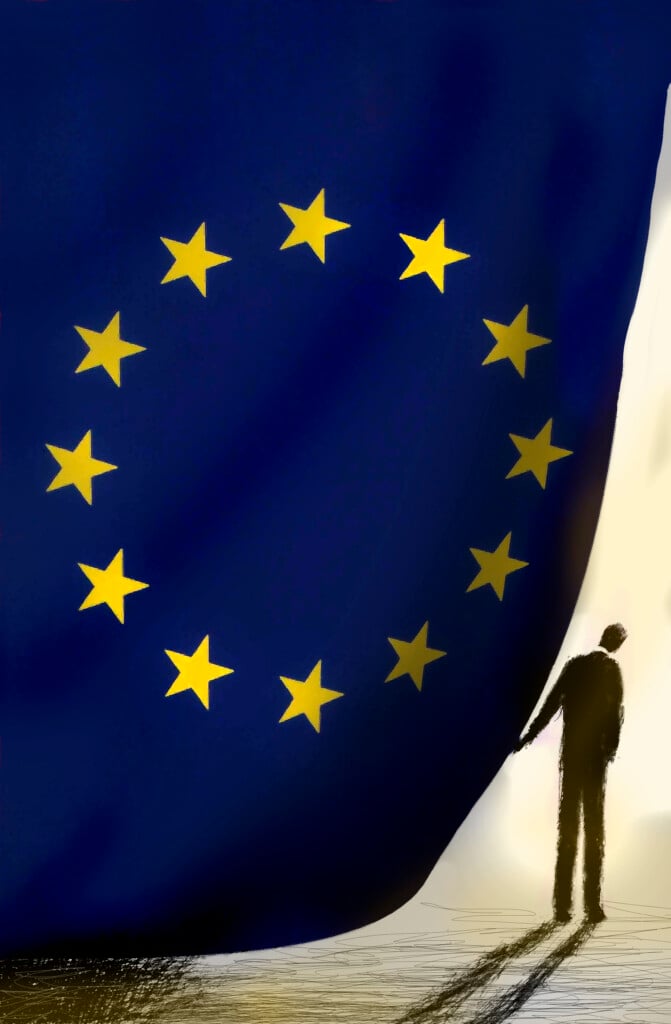
For a long time now, while pretending nothing was wrong, the European Union has started to regress. National prerogatives – which were never reduced below the threshold that would have subordinated them to European sovereignty – have only gained ground, eventually producing the British secession. Tensions have grown behind the curtain of rhetoric – and not only the obvious acrimonious ones with Eastern countries. But above all, the political composition of the Old Continent, which had formed and then stabilized in the post-war period, has changed. Nationalist parties and movements have reached such a size that they exert strong influence in most European countries. Even when they are not in government, they impose their pet agendas on the centrist governing forces.
Social democracies, which used to be a decisive component of the pro-European push, have catastrophically unraveled across the continent, adopting the arguments of their opponents according to a perverse logic – from the sealing of borders to the dismantling of the right to asylum. In Europe’s eastward enlargement, they went along with the ferocious neoliberal colonizing drive (especially from Germany) in the post-1989 era, which produced an authoritarian anti-liberal reaction that is today drawn to the reactionary model of Putin’s Russia or, conversely, driven by virulent anti-Russian resentment.
As for the more radical left, always in the minority, it has repeatedly shown its hostility to the neoliberal inspiration that gave rise to the Union. In short, Europe has progressively lost that drive for unification which didn’t just serve corporate or contingent interests but aimed at going beyond national priorities.
The drive to downsize national sovereignty is now so weak that even the sovereignists themselves – at least the most astute ones – no longer have any qualms about displaying pro-European credentials, which costs them nothing. It is therefore not surprising that in the matter of finding a solution to end the war between Russia and Ukraine, a collective subject that is fragmented between the “coalition of the willing” (up to a point), the reluctant, the paid-for Trumpists, the pro-Russians and the ideological or entrepreneurial warmongers has many voices but no say in the matter.
Furthermore, there is no government in Europe that displays such stability and consistency that it would be immune to the blackmail of the most radical right, whether in direct or indirect form. Friedrich Merz, Emmanuel Macron, the UK’s Keir Starmer, the Italian Trump worshipers, the northern European governments from the Netherlands to Denmark, the Scandinavian former progressives and the petulant Baltics are together a confused multiplicity of weaknesses – all loudly lined up in support of Ukraine, but with different intentions and different calculations. It is a multiplicity completely devoid of planning capacity.
Even in events taking place on its doorstep, Europe is not in a condition to count for anything. If anything, the strongest of its countries will try to do so by playing their national cards alone. The only forces capable of occupying the supranational space are those of the mass movements, which will not impose peace treaties that are more or less unjust and precarious, but could, however, boycott the war. Far from having reached a critical mass, they nevertheless show a significant presence in many countries. After all, it doesn’t take much to carry more weight than Brussels.
Originally published at https://ilmanifesto.it/europa-tante-voci-nessuna-in-capitolo on 2025-11-26