
Analysis
Colombia’s Santa Marta conference charts pathways to phase out fossil fuels
The real crux of the matter is how to move away from economies built for decades around fossil fuel rents without shifting social costs onto workers, communities and regions. The United States was absent, of course.
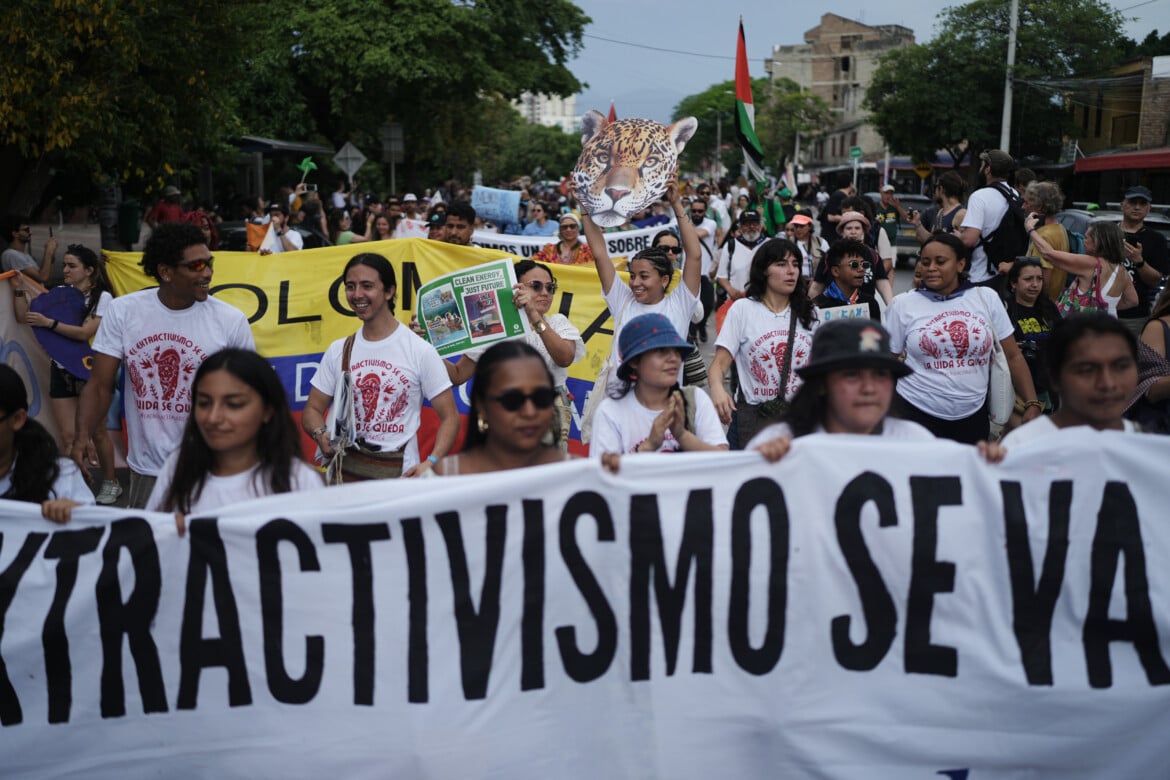
While the news shows, deep-dive investigations and major newspapers were busy reporting nonstop on the consequences of the joint US-Israeli attack on Iran and the political and (most of all) economic concerns surrounding the Strait of Hormuz, the Santa Marta Conference in Colombia – the first international event explicitly dedicated to the transition away from fossil fuels – was met with an almost deathly silence in the media.
Yet its timing could not have been more fitting. If a single geopolitical crisis is enough to shake up markets, governments and utility bills, it means that dependence on oil, gas and coal is more than just a climate issue: it is a matter of international security, economic sovereignty, social justice and democracy. Santa Marta sought to convey precisely this fact: fossil fuels are the material infrastructure of an unstable, unjust and violent world order.
The conference, launched at COP30 and co-chaired by Colombia and the Netherlands, was attended by delegations from 57 countries plus the European Union. Not just importing nations or small, vulnerable countries, but also producing nations: Canada, Australia, Nigeria, Ghana and Colombia itself. This is a significant political development: the transition, now being discussed also with those who extract, export and depend financially on fossil fuels, is beginning to grapple with the real issue.
The real crux of the matter is how to move away from economies built for decades around fossil fuel rents without shifting social costs onto workers, communities and regions.
The United States was absent, of course. Many major polluters were absent. But the choice was clear: not to wait for the consent of those who are blocking all progress. First consolidate an alliance, then expand it. Not a retreat from the COPs, but an attempt to build bargaining power to carry back into the UN multilateral process so that it becomes a venue for concrete implementation and ceases to be merely an arena where ministers negotiate every single comma of a text down to the last minute. After all, it is precisely in order to break this deadlock that part of climate diplomacy today relies on plurilateral initiatives capable of pushing forward where universal consensus stalls.
Santa Marta did not produce a binding document, but it did produce a method. The value of the process also lies in having created a less rigid political space capable of fostering dialogue among governments, civil society, science, labor unions, indigenous peoples, movements and financial institutions. No watered-down text was negotiated: the participants cooperated to define a working agenda. This is where the difference lies with the ritualistic COP, where the opposition of a single party is enough to neutralize proposals supported by broad coalitions.
After Santa Marta, we have three operational strands: national and regional roadmaps for phasing out fossil fuels; work on macroeconomic dependencies, from debt to subsidies; and cooperation between producer and consumer countries to transform investments and trade balances.
But we also bring home a significant practical tool: the Scientific Panel for Global Energy Transition, a scientific panel launched by Rockström and Nobre designed to guide countries in building pathways consistent with the 1.5°C target and to identify and remove the technical, financial and political barriers to the transition.
Europe was represented by 14 member states and the European Commission. It was a significant presence, albeit one marked by ambiguity: even today, Brussels is more willing to talk about reducing emissions than eliminating fossil fuels. As Wopke Hoekstra, European Commissioner for Climate Action, said in unambiguous terms: “you cannot be at 90% [of emission cuts] in 2040 if you will not radically phase out fossil fuels.” France arrived in Santa Marta presenting a national roadmap. Not perfect, but concrete: phasing out coal by 2030, oil by 2045 and gas by 2050; a gradual halt to new extraction permits; and sectoral planning for electrification, heating, transportation and industry.
This is an important precedent because it shifts the discussion from generic commitments to public planning: dates, tools, social conflicts to manage and investments to direct.
What about Italy? It was there – and that is already something. It is better to be there, even just to watch, than to remain outside a space destined to grow and move in the right direction. But our country’s presence remains marked by an obvious contradiction: participating in a conference on phasing out fossil fuels while, domestically, we continue to treat gas as a long-term strategic infrastructure, defend new fossil fuel projects and postpone cuts to environmentally harmful subsidies.
From Santa Marta, pressure must be brought to bear on individual countries, including Italy, to ensure they adopt roadmaps, outline how they intend to reduce their dependence on imports, cut subsidies, rethink infrastructure, revise energy plans and balance the needs of the workforce and local communities.
The next meeting will be held in Tuvalu in 2027, co-chaired by Ireland. This, too, is a deliberate choice: to bring the process to the Pacific, where rising sea levels are not a future prediction but a daily threat.
It is clear that Santa Marta does not represent a point of arrival, but a shift in pace: it inaugurates a new kind of climate diplomacy, more pluralistic, more operational and finally capable of overcoming the taboo on naming fossil fuels as the culprit. In the words of Minister Vélez Torres, “removing taboos is already a profound transformation of politics.” Now we must translate this momentum into rules, financial instruments and public policies. Because the fossil fuel era will not end on its own: it must be brought to a close.
Originally published at https://ilmanifesto.it/la-democrazia-climatica-di-santa-marta-per-uscire-dallera-fossile on 2026-05-07